
Reviewed by Peter Berk, President and Chief Media Strategist, Berk Marketing · Last updated 8 November 2026
TL;DR
Connected TV advertising cost is not a single number. It depends on how you buy, who you target, what content environment your ad runs in, and how many intermediaries sit between your budget and the screen. The CPM you see quoted online is the media cost only, not the total. Fee layers, data charges, and platform markups can consume a significant share of your spend before a single ad reaches a viewer. This guide explains every factor that moves the price and why the buying route matters more than any published rate.
Planning a radio or TV buy? Tell us what you sell and who buys it, and we come back with a free written media plan. No obligation.
Request a Free Media Planor call (866) 747-4707Advertisers researching connected TV advertising cost typically want a straightforward answer: a dollar figure, a range, maybe a table comparing platforms. Every competing page on the internet tries to give them one. The problem is that those numbers are misleading at best and deceptive at worst. A CTV cost figure stripped from context tells you almost nothing about what you will actually pay or what you will get for it.
This page takes a different approach. Instead of publishing rate benchmarks that will be outdated by the time you read them, it explains the forces that determine your real cost, the hidden fees that inflate it, and the buying decisions that can bring it back down. If you are planning a connected TV advertising campaign and want to understand the economics before talking to a seller, this is the right starting point.
For a broader overview of the channel itself, including how it works and where ads appear, the full CTV advertising guide covers the fundamentals.
How Much Does Connected TV Advertising Cost?
Connected TV (CTV) advertising costs vary depending on audience targeting, streaming inventory, geographic reach, ad length, campaign duration and buying method. Most CTV campaigns use a cost-per-thousand-impressions (CPM) pricing model, but the quoted CPM does not represent the full campaign cost. Advertisers may also pay for audience data, demand-side platform (DSP) technology, ad verification, measurement and agency management. To estimate the actual cost, advertisers should compare the total campaign budget against the impressions delivered and account for all additional fees.
Connected TV Advertising Cost: What Determines the Price?
There is no universal price for connected TV advertising. The total cost depends on the inventory purchased, audience requirements, campaign scale and fees charged by the platforms or service providers involved.
The following table summarizes the main cost drivers advertisers should evaluate before requesting a CTV media plan.
Cost factor | How it affects CTV advertising cost |
|---|---|
Audience targeting | Narrow demographic, behavioral and household targeting can increase CPMs. |
Streaming inventory | Premium streaming services, live sports and popular programming can command higher prices. |
Geographic targeting | Competitive metropolitan areas and specific local markets can increase demand and pricing. |
Seasonality | Q4, major sporting events and election periods can increase competition for inventory. |
Ad length | Longer commercials generally consume more inventory and may cost more. |
Buying method | Direct publisher deals, DSP purchases and managed-service arrangements have different fee structures. |
Campaign scale | Larger budgets and longer commitments may provide better negotiating opportunities. |
Additional fees | Data, technology, verification and management charges increase the total campaign cost. |
Important: These factors influence pricing differently depending on the publisher, platform and campaign. A higher CPM does not automatically mean better inventory or better campaign performance.
How CTV Advertising Is Priced
Most connected TV advertising is sold on a CPM basis, meaning cost per mille, or cost per thousand impressions. You pay a flat rate each time your ad is shown to one thousand viewers. This gives advertisers a predictable unit of cost and makes it easy to compare one opportunity against another on paper.
But CPM is a pricing metric, not a price. The rate you are quoted will shift depending on the platform, the audience you want to reach, the programming your ad runs alongside, the geography you target, the time of year, and the deal structure. Two advertisers buying what appears to be the same inventory can pay very different amounts because of differences in any one of those variables.
The CPM model also only accounts for the media cost. It does not include the technology fees, data charges, verification costs, and management overhead that accumulate between your budget and the publisher’s ad server. Understanding the full cost requires looking beyond the headline number.
How to Calculate a Connected TV Advertising Budget
Advertisers can estimate their CTV media budget using the CPM pricing formula:
CTV Media Cost = (Total Impressions ÷ 1,000) × CPM
For example, suppose a business wants to deliver 500,000 CTV impressions at an illustrative CPM of $25.
The calculation would be:
Total impressions: 500,000
Illustrative CPM: $25
Impressions divided by 1,000: 500
Estimated media cost: 500 × $25 = $12,500
However, this figure represents the media cost only. It does not include additional charges for audience data, technology, verification, creative production or campaign management.
Example CTV Advertising Budget Scenarios
The following scenarios demonstrate how impression volume and CPM affect media spending. These are mathematical examples, not verified market-rate benchmarks or publisher quotations.
Campaign scenario | Illustrative CPM | Impressions | Media cost |
|---|---|---|---|
Small test campaign | $20 | 100,000 | $2,000 |
Local awareness campaign | $25 | 250,000 | $6,250 |
Regional campaign | $30 | 500,000 | $15,000 |
Larger awareness campaign | $35 | 1,000,000 | $35,000 |
High-volume campaign | $40 | 2,000,000 | $80,000 |
These examples are intended to explain the relationship between CPM, impressions and media spending. Actual CTV rates vary by inventory, targeting, publisher, geography and buying arrangement.
Why Your Total CTV Budget May Be Higher
A $15,000 media campaign does not necessarily mean the advertiser only needs $15,000.
The final amount may also include:
DSP and programmatic technology fees
Third-party audience data
Ad verification and fraud prevention
Measurement and attribution
Agency or campaign management
Creative production and editing
Always ask whether a quoted budget represents working media, total media spend or the complete campaign investment.
What Drives Connected TV Advertising Cost
Seven factors consistently determine where your CTV cost lands on the spectrum. None of them operates in isolation, and most interact with each other.
Audience Targeting Specificity
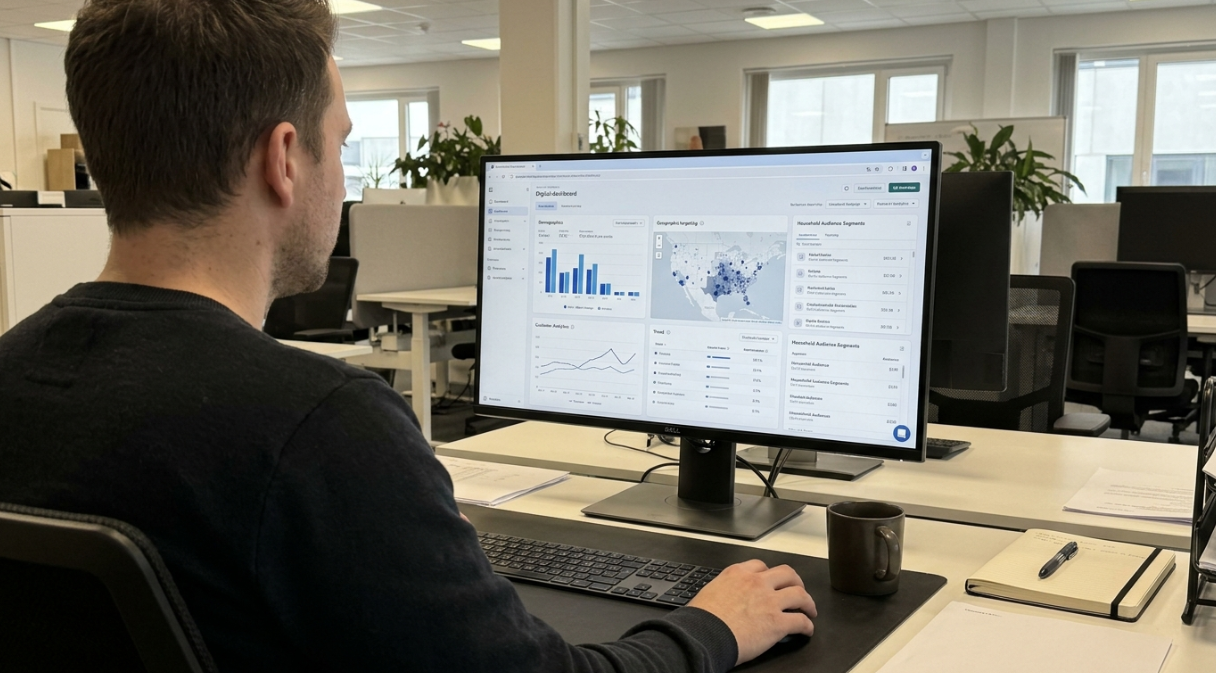
The more precisely you define who should see your ad, the more each impression costs. A campaign targeting all adults 25 to 54 in a broad geography will carry a lower CPM than one targeting homeowners over 50 with household income above a specific threshold in three zip codes. Narrow targeting reduces waste, but it also reduces available inventory, and scarcity pushes the price up.
This is the fundamental tradeoff in CTV: you can reach exactly the right households, but precision costs money. The question is whether the reduction in wasted impressions justifies the higher per-impression price. Usually it does, but only if the targeting is informed by actual customer data rather than guesswork.
Inventory Quality and Content Environment
Not all CTV inventory is created equal. A thirty-second spot inside a premium streaming series costs more than the same spot on a free ad-supported channel running older syndicated programming. Live sports, breaking news, and new theatrical releases command the highest premiums because they draw engaged, concentrated audiences.
The environment your ad appears in affects both cost and performance. Premium content signals credibility. A viewer watching a show they actively chose and are paying for is in a different mindset than someone flipping through a free channel. Advertisers interested in how premium streaming inventory is structured can read more about Amazon Prime Video advertising, one of the platforms Berk Marketing buys through.
Geography and Market Size
CTV can be targeted by designated market area, state, zip code, or even individual household. Larger, more competitive markets cost more because demand for those audiences is higher. Political advertising, which floods certain markets during election cycles, can inflate costs significantly in battleground states and competitive congressional districts.
Local competition matters too. If several advertisers in your category are already buying CTV inventory in your market, the available supply for your audience shrinks and the price rises. This is the same dynamic that affects radio advertising costs in major markets.
Seasonality and Demand Cycles
Connected TV advertising cost is not static across the calendar. Q4 is the most expensive quarter because retail, e-commerce, travel, and financial services advertisers all increase spending simultaneously. Major sporting events (the Super Bowl, March Madness, the NFL playoffs, the Olympics) create demand spikes that push premiums on live and adjacent inventory.
Election years compound the effect. Political advertisers spend heavily on CTV because of its targeting precision, and that spending competes directly with commercial advertisers for the same impressions in the same markets.
Ad Length
A thirty-second spot costs more than a fifteen-second spot, but not exactly twice as much. Longer formats consume more of a limited ad pod, so publishers charge a premium that reflects both time and opportunity cost. Some platforms also offer non-standard lengths like six or ten seconds for specific awareness objectives.
For direct-response advertisers who need time to present an offer and repeat a call to action, the thirty-second format is usually the minimum that works. The cost difference between fifteen and thirty seconds is worth it if the additional time generates a measurable response. The same principle applies to radio ad length, where sixty seconds is standard for direct response because the message needs room to land.
Buying Route
This is the factor most competing articles understate, and it may be the most important one. Connected TV advertising cost is shaped not just by what you buy but by how you buy it.
There are several routes to CTV inventory: buying directly from a publisher, buying through a demand-side platform (DSP) using programmatic auctions, buying through a managed-service agency, or buying through an independent media buyer who has direct relationships with CTV publishers.
Each route carries a different fee structure, a different level of transparency, and a different degree of control over where your ads actually run. A practitioner analysis from Stillwater Media put it well: CTV advertising cost is best understood as a spectrum where price tracks three things: how well the publisher can prove who is watching, how scarce the moment is, and how many intermediaries are standing between your budget and the screen.
The distinction between buying through a media buyer versus a sales rep applies to CTV just as it does to radio. A seller represents their own inventory. A buyer represents the advertiser.
Comparing CTV Advertising Buying Methods
Advertisers can access connected TV inventory through several purchasing arrangements. Each method offers a different balance of control, transparency, service and cost.
Buying method | How it works | Potential advantages | Potential disadvantages |
|---|---|---|---|
Direct publisher buying | Advertiser purchases inventory directly from a streaming publisher. | Direct publisher relationship, clearer inventory ownership and placement options. | May require larger commitments and multiple publisher relationships. |
Programmatic DSP buying | Advertiser uses a demand-side platform to bid on available CTV impressions. | Automated buying, audience targeting and access to multiple inventory sources. | Technology, data and supply-chain fees can reduce working media. |
Managed-service platform | A provider manages campaign setup, targeting, optimization and reporting. | Less operational work for advertisers without an internal media team. | Management fees and limited visibility may affect total cost. |
Independent media buying | An independent buyer plans and negotiates media purchases on the advertiser’s behalf. | Potentially stronger negotiation, cross-publisher planning and advertiser-focused advice. | Results depend on the buyer’s relationships, expertise, fees and inventory access. |
Which buying method is best?
There is no universally cheapest or best option. Direct buying can work well when an advertiser knows which publisher and audience it wants. Programmatic buying offers flexibility and automation. Managed-service and independent media buying can be useful when an advertiser needs specialized planning and negotiation support.
Before choosing a provider, compare the total campaign cost, inventory transparency, reporting access, management fees and actual amount of budget allocated to working media.
Campaign Scale and Commitment Length
Volume and duration reduce cost per impression. Multi-month commitments lower management fees. Annual creative agreements reduce per-spot production costs. Larger media commitments earn better CPMs because publishers prefer guaranteed revenue over spot buys. Upfront commitments, where advertisers lock in spending ahead of a broadcast season, typically carry better rates than scatter market buying.
This is why short test flights at minimal budgets rarely reflect the true cost efficiency of CTV. The channel rewards commitment.
What Is the Minimum Budget for CTV Advertising?
There is no universal minimum budget for connected TV advertising. The amount required depends on the platform, publisher, buying method, audience size and campaign objectives.
Some self-service advertising platforms allow relatively small daily budgets, while direct publisher agreements and premium inventory purchases may require substantially larger commitments.
Advertisers should distinguish between the minimum amount needed to activate a campaign and the amount needed to generate meaningful results.
What Determines Your Minimum CTV Budget?
Several factors influence the minimum practical campaign investment:
Platform requirements: Self-service platforms and managed-service providers have different spending thresholds.
Audience size: Narrow geographic or demographic targeting may limit available impressions.
Campaign duration: A campaign running for several weeks needs enough budget to maintain consistent delivery.
Market competition: Competitive locations and premium inventory can require higher spending.
Measurement requirements: Advanced attribution, audience measurement and independent verification may add costs.
Creative production: Advertisers without an existing television-ready commercial may need a separate production budget.
How Much Should You Allocate to a CTV Test Campaign?
Instead of choosing a budget based only on a platform’s minimum requirement, calculate how many impressions you need to evaluate the campaign.
For example, an advertiser should establish:
The geographic area they want to reach.
The audience they want to target.
The estimated CPM and available inventory.
The campaign duration.
The response or awareness metrics they will measure.
A small campaign can help test creative and audience assumptions, but it may not generate enough data to establish reliable performance across multiple markets or audience segments.
The best starting budget is one that supports meaningful delivery, measurable objectives and a realistic evaluation period.
Why the Quoted CPM Is Not the Real Cost
This is the section most CTV cost articles skip entirely, and it is the one that matters most if you are trying to build an honest budget.
The Fee Stack
The CPM a vendor quotes is the media cost: what the publisher receives (or a portion of what the publisher receives) for showing your ad. But between your budget and that publisher sits a chain of technology platforms, data providers, and service fees, each taking a percentage.
A programmatic CTV buy typically involves some or all of the following charges on top of the media CPM:
Demand-side platform (DSP) fees
Audience data licensing
Identity resolution and device onboarding
Ad serving fees
Supply-side platform (SSP) technology fees
Viewability and fraud verification
Brand safety monitoring
Measurement and attribution technology
Agency or managed-service management fees
Stacked together, these fees can create a significant gap between what the advertiser pays and what actually reaches the screen as working media.
According to an analysis obtained by MediaPost, brands that buy CTV ads through programmatic platforms can pay more than double the markup compared to what they would pay using an agency to buy the same ads directly from publishers. That is not a rounding error. It is a structural difference in how the money flows.
Example: How Additional Fees Increase Your Effective CTV CPM
Consider an advertiser purchasing 500,000 CTV impressions at an illustrative media CPM of $25.
The initial media cost is:
500,000 ÷ 1,000 × $25 = $12,500.
Now assume the campaign also incurs the following hypothetical charges:
Campaign expense | Illustrative cost |
|---|---|
CTV media cost | $12,500 |
DSP and technology fees | $1,000 |
Audience data charges | $750 |
Verification and measurement | $500 |
Campaign management | $1,250 |
Total campaign cost | $16,000 |
The advertiser initially sees a $25 CPM, but the actual cost per thousand impressions becomes:
$16,000 ÷ 500 = $32 effective CPM.
That represents a 28% increase over the original media CPM.
This example illustrates why advertisers should request a complete cost breakdown before approving a campaign. Two providers quoting the same media CPM may deliver very different total costs once technology, data and management fees are included.
Note: These figures are hypothetical examples for explaining the calculation. Actual fees and billing arrangements vary by provider.
The Working Media Problem
The Association of National Advertisers (ANA) has been tracking programmatic transparency for years, and the numbers are sobering. The ANA’s Q3 2025 Programmatic Transparency Benchmark found that “working media” on web and mobile programmatic advertising buys had risen from 36.0% in 2023 to 47.1% as of Q3 2025. That means even after significant industry improvement, less than half of programmatic ad spend was reaching actual media inventory.
CTV programmatic buying faces the same structural challenge. Jounce’s mid-2025 research found that unnecessary resale layers in the supply path have now overtaken low-quality inventory as the primary source of waste in programmatic. The intermediaries themselves, not the content or the audience, are the biggest drain on budget.
Effective CPM vs. Nominal CPM
Here is a concept that changes the math entirely. Broadcast television might show a lower CPM on paper. But if only a fraction of that audience matches your target customer, your effective cost to reach a relevant household is much higher than it looks. CTV, with tighter audience matching, can deliver a lower effective CPM per target household despite a higher nominal rate.
This distinction is critical. The headline cost of CTV looks expensive compared to traditional TV. The cost per relevant impression, adjusted for waste, often tells the opposite story. But you will only see that advantage if the targeting is set up correctly and the intermediary fees are controlled.
CTV Cost Compared to Other Channels
CTV Advertising Cost Compared to Other Advertising Channels
Connected TV is not necessarily the cheapest advertising channel. Its value comes from combining television-style video advertising with digital audience targeting and impression-based measurement.
However, advertisers should compare channels based on their objectives, targeting requirements and total acquisition costs rather than CPM alone.
Advertising channel | Common pricing model | Main advantage | Main limitation |
|---|---|---|---|
Connected TV | CPM | Household-level targeting and full-screen video advertising. | Additional technology, data and inventory fees can increase costs. |
Broadcast TV | CPM or negotiated placement rates | Broad audience reach and mass-market exposure. | Less precise audience targeting. |
Cable TV | CPM or negotiated placement rates | Access to specific networks and programming audiences. | Audience fragmentation and limited household-level targeting. |
Paid search | CPC or CPA | Captures existing search intent. | Limited ability to create demand before a consumer searches. |
Social media advertising | CPM, CPC or CPA | Flexible targeting, creative testing and engagement. | Feed-based viewing behavior differs from television viewing. |
Radio advertising | CPM or negotiated spot rates | Repeated audio exposure and geographic targeting. | Does not provide the same visual storytelling as CTV. |
Is CTV More Expensive Than Other Advertising Channels?
CTV often carries a higher nominal CPM than some traditional and digital advertising formats. However, CPM alone does not reveal how efficiently a campaign reaches its intended audience.
Advertisers should also evaluate:
Cost per qualified household reached.
Cost per completed video view.
Incremental reach beyond existing media channels.
Cost per website visit or qualified lead.
Cost per acquisition.
Return on advertising spend.
For example, a lower-cost campaign that reaches a large but poorly matched audience may produce fewer qualified leads than a more expensive campaign with better audience alignment.
The right comparison is therefore not simply which channel has the lowest CPM. It is which channel delivers the most valuable audience and business outcome for the total investment.
CTV vs. Linear Cable and Broadcast
Linear television still reaches massive audiences at scale, and its CPMs can be lower in absolute terms. But linear buying is blunt. You buy a program, a daypart, or a network, and whoever is watching sees your ad. There is no household-level targeting, limited geographic precision (outside local broadcast), and measurement relies on panel-based estimates rather than impression-level data.
CTV costs more per impression but wastes less of every dollar. For advertisers with a defined target audience and a specific geography, the effective cost comparison often favors CTV. For advertisers who need the broadest possible reach and are less concerned about targeting precision, linear still has a role.
The reality is that most serious advertisers use both. eMarketer’s December 2025 forecast projects U.S. CTV ad spending to reach $37.95 billion in 2026, up 14.5% from $33.35 billion in 2025. For the first time, CTV upfront spending ($17.73 billion) is expected to exceed primetime linear upfront spending ($16.98 billion), according to eMarketer’s Q2 2026 Digital Video Forecast. The migration is real, but it is a shift in mix, not a wholesale replacement.
CTV vs. Social and Search
Social media and paid search operate at different points in the funnel and use different pricing models (cost per click, cost per action, cost per engagement). Comparing their CPMs directly to CTV is like comparing the price of a billboard to the price of a direct mail piece. The units are different.
CTV delivers a full-screen, sound-on video ad in a living room environment. Social delivers a scroll-past ad in a feed. Search captures intent that already exists. CTV builds the intent that search later captures. They are complementary, not interchangeable.
Despite CTV’s growing importance, eMarketer notes that the format remains somewhat inaccessible for smaller advertisers due to higher CPMs, agency costs, and the spending commitments often required by streaming platforms. Combined with the need for specialized knowledge, many small businesses default to search and social simply because the barrier to entry is lower.
CTV Planned Alongside Radio
When CTV and national radio advertising are planned by the same buyer, the targeting and measurement align. The same geographic markets, the same audience definitions, and the same attribution framework apply across both channels. Radio builds frequency and brand recall during drive time and throughout the day. CTV reinforces the message in the evening with full-motion video in the living room.
This cross-channel coordination is one of the reasons Berk Marketing plans both from the same desk. Peter Berk has bought radio since 1978 and now buys CTV through Amazon Ads, working with longtime radio industry colleagues who run CTV businesses. That relationship-based access gets advertisers into inventory and deal structures that a self-serve platform cannot replicate.
For advertisers comparing audio and video costs side by side, SiriusXM advertising costs follow a similar principle: the published rate is an opening position, not a price.
CTV for Direct-Response Advertisers
Most CTV cost discussions default to a brand awareness framing. They talk about reach, frequency, and completion rates. That framing misses the point for advertisers who need the phone to ring.
DRTV is a strategy. It defines how an ad is designed and what outcome it drives. CTV is a distribution channel. It defines where that ad appears. The two work together when the creative is built for response: a clear offer, a reason to act now, and a call to action repeated with enough clarity that a viewer can act from the couch.
According to a survey by Advertising Week and MNTN, 65% of marketers now classify CTV as a performance channel, and 52% use it to drive metrics like web visits and revenue. The industry is catching up to what direct-response advertising practitioners have known for decades: if the ad is built to generate action, the channel can deliver it.
But a CTV impression is not a response. A report full of completion rates tells you nothing about whether anyone called. The same discipline that applies to radio attribution, unique tracking numbers per station and per platform, agreed before launch rather than after, applies to CTV. If you are not tracking calls from your television advertising, you are guessing.
Berk Marketing positions CTV as the television side of its direct-response work: targeted by household, geography, and audience, measurable by actual response, and planned by the same person who plans the radio.
CTV Ad Fraud and the Cost of Wasted Impressions
Any honest discussion of connected TV advertising cost has to address fraud and waste. They are part of the real cost, whether they show up on an invoice or not.
DoubleVerify’s 2025 Global Insights Report found that bot-driven activity accounted for 65% of CTV fraud, with an estimated four million infected devices generating fake traffic daily. If a portion of your impressions are being served to bots rather than people, your effective cost per human viewer is higher than the CPM suggests.
This is exactly where the buying route matters most. An independent buyer who knows the publishers, who has verified the supply path, and who represents the advertiser rather than the platform can eliminate waste that no amount of self-serve optimization will catch.
How to Measure Connected TV Advertising ROI

The cost of a CTV campaign should not be evaluated by CPM alone. Advertisers also need to understand whether their investment generated meaningful business outcomes.
Depending on the campaign objective, CTV performance can be measured through reach, completed views, website visits, phone calls, leads, conversions and revenue.
Important CTV Advertising Performance Metrics
Metric | What it measures | Why it matters |
|---|---|---|
CPM | Cost per 1,000 impressions | Measures the price of media delivery. |
Reach | Number of unique viewers or households exposed | Shows how many potential customers the campaign reached. |
Frequency | Average number of exposures per reached household | Helps evaluate repeated exposure and potential overdelivery. |
Video completion rate | Percentage of video impressions completed | Indicates whether viewers watched the full advertisement. |
Cost per completed view | Cost of generating completed video views | Helps compare video delivery efficiency. |
Website visits | Visits attributed to or associated with campaign exposure | Indicates whether advertising encouraged further engagement. |
Cost per lead | Campaign cost divided by leads generated | Measures lead-generation efficiency. |
Return on ad spend (ROAS) | Revenue attributed to advertising divided by advertising spend | Helps evaluate revenue performance. |
How to Calculate CTV Advertising ROI
Advertisers can use two common calculations:
Cost per lead:
Total campaign cost ÷ Number of qualified leads generated.
Return on ad spend (ROAS):
Revenue attributed to advertising ÷ Advertising spend.
For example, if an advertiser spends $20,000 on a CTV campaign and generates $60,000 in attributable revenue, the campaign produces a 3:1 ROAS.
That means the campaign generated $3 in attributed revenue for every $1 spent.
However, attribution does not automatically prove that CTV caused all the reported revenue. Advertisers should distinguish between attributed conversions and incremental conversions that would not have occurred without the campaign.
How to Track Calls and Website Visits From CTV Ads
Direct-response advertisers can use several tracking methods:
Dedicated phone numbers displayed in television commercials.
Unique landing pages for specific campaigns.
QR codes that viewers can scan using a mobile device.
Campaign-specific promotional codes.
Website conversion tracking.
Geographic and audience-based lift studies.
For advertisers whose primary objective is phone calls, unique tracking numbers can help identify responses associated with different campaigns and media placements.
The strongest measurement approach combines delivery metrics with actual business outcomes. A high video completion rate is useful, but it does not automatically mean the campaign generated profitable leads or sales.
How to Get a Real Connected TV Advertising Cost Estimate
Published CTV rates online should be treated as guidelines rather than guaranteed rates. As one practitioner guide from Directive Consulting notes, a vendor’s CTV pricing benchmark may reflect the vendor’s own inventory, target market, reporting definitions, commercial model, and buying approach. Those variables make generic benchmarks nearly useless for planning a specific campaign.
Here is a better approach:
Talk to a buyer before approaching a seller. This principle, which Berk Marketing applies to radio rate negotiation and every other channel, is even more important in CTV because the fee stack is more complex and less transparent. Once a seller has quoted you directly, the negotiation dynamics change permanently.
Request a custom TV media plan, not a rate card. A real plan accounts for your specific audience, geography, competitive environment, creative needs, and response objectives. It shows you what the total cost looks like after fees, not just the media CPM.
Insist on transparency about the fee stack. Ask how many intermediaries sit between your budget and the publisher. Ask what percentage of your spend reaches working media. If the answer is vague, that is itself an answer.
Plan CTV as part of a broader media mix. CTV planned in isolation is more expensive and harder to measure than CTV planned alongside radio, audio, and other direct-response channels by a single buyer who aligns the targeting and attribution.
What to Ask Before Accepting a CTV Advertising Quote
Before committing to a connected TV campaign, ask the provider to explain exactly what is included in the proposed price.
Use this checklist to compare competing media plans.
CTV Inventory and Placement
Which streaming publishers and applications will show the advertisements?
Will the campaign use premium inventory, programmatic inventory or a combination?
Can the advertiser see where the advertisements actually ran?
Are live sports, premium programming or other high-demand placements included?
Audience and Targeting
Which demographic, behavioral or household segments are available?
How is the audience data collected and verified?
Can the campaign target specific geographic markets or ZIP codes?
What is the estimated reachable audience size?
Pricing and Additional Fees
Is the quoted CPM the media-only rate or the complete campaign rate?
Are DSP, data and ad-serving fees included?
Are verification and measurement charges separate?
Is there an additional agency or management fee?
What percentage of the total budget goes toward working media?
Measurement and Reporting
Will reporting include impressions, reach and frequency?
Can the advertiser access completed-view metrics?
Are invalid traffic and fraud monitoring included?
Can website visits, calls and conversions be tracked?
How frequently will campaign performance be reported?
Contract and Campaign Flexibility
Is there a minimum spending commitment?
Is the campaign subject to a minimum contract period?
Can targeting and creative be adjusted during the campaign?
Are there additional fees for changing or ending the campaign?
A transparent CTV proposal should explain the inventory, targeting, full cost structure, campaign duration and measurement methodology. If a provider cannot clearly explain these elements, request clarification before committing your advertising budget.
Frequently Asked Questions
How is connected TV advertising priced?
Most CTV advertising is sold on a CPM (cost per thousand impressions) basis. You pay a set rate for every thousand times your ad is displayed. However, the CPM is only the media component. Technology fees, data costs, verification charges, and management overhead add to the total. The real cost depends on your targeting, geography, content environment, ad length, time of year, and buying route.
Why do CTV rates vary so much from one source to another?
Because every quote reflects a different combination of variables. One vendor’s benchmark may be based on run-of-network inventory across free channels, while another quotes premium live sports inventory with household-level targeting. The buying method (programmatic auction versus direct publisher deal versus agency-managed) changes the fee structure entirely. Without controlling for these variables, comparing published rates is meaningless.
Is connected TV advertising cost higher than traditional TV?
The nominal CPM for CTV is typically higher than broadcast or cable television. But nominal CPM does not account for audience waste. Traditional TV reaches everyone watching a program, whether they match your customer profile or not. CTV targets specific households. The effective cost per relevant viewer is often lower on CTV despite the higher headline rate.
What hidden costs should I expect beyond the CPM?
DSP fees, audience data licensing, identity resolution, ad serving, supply-side platform charges, viewability verification, brand safety monitoring, measurement technology, and agency management fees all stack on top of the media CPM. The ANA found that less than half of programmatic ad spend reached working media as of Q3 2025. Asking for a full cost breakdown before committing budget is essential.
Can CTV work for direct-response advertising?
Yes. CTV is increasingly used as a performance channel, with 65% of marketers classifying it that way according to a survey by Advertising Week and MNTN. The key is building creative that drives a specific action (a phone call, a website visit, a form submission) and measuring actual response rather than relying on impression counts or completion rates.
How does the buying route affect my CTV cost?
Significantly. Buying programmatically through a DSP involves platform fees and data charges that can more than double the effective cost compared to buying directly from a publisher through an agency. The number of intermediaries between your budget and the screen is one of the largest determinants of your actual cost per impression.
Should I buy CTV through a self-serve platform or through a media buyer?
A self-serve platform gives you access to inventory but no leverage, no publisher relationships, and no protection against supply-path waste or fraud. An independent media buyer who represents the advertiser, not the platform, can negotiate better terms, verify the quality of inventory, and align CTV with other channels in your media plan. The choice depends on your team’s expertise and the scale of your campaign, but for most serious advertisers, the buyer pays for itself in waste reduction alone.
How does Berk Marketing buy connected TV?
Berk Marketing buys CTV through Amazon Ads, planned by the same person, Peter Berk, who has bought radio since 1978. Peter works with longtime radio industry colleagues who now run CTV businesses, and those relationships give advertisers access to inventory and deal structures that self-serve platforms do not offer. CTV and radio are planned together so targeting and measurement align across channels.
No cost, no obligation. Or call (866) 747-4707 and speak with Peter Berk directly.
Request a free radio media plan
Tell us who you want to reach and what you want to accomplish. No obligation, and nothing is placed until you approve it.
Ready to plan your radio buy?
Berk Marketing represents advertisers, not radio stations or media companies.