
Reviewed by Peter Berk, President and Chief Media Strategist, Berk Marketing · Last updated 8 November 2026
TLDR
Radio advertising can generate phone calls, but without a measurement system, it is difficult to know which stations, schedules, and commercials are producing valuable leads. Call tracking helps advertisers connect inbound calls to specific radio campaigns and evaluate whether those calls turn into customers.
Planning a radio or TV buy? Tell us what you sell and who buys it, and we come back with a free written media plan. No obligation.
Request a Free Media Planor call (866) 747-4707This guide explains how to set up radio call tracking, choose the right number structure, measure qualified calls and sales, and account for listeners who respond later through search, websites, or business listings. It also covers how to combine call logs, as-run schedules, and CRM data to make better radio buying decisions.
How Do You Track Calls From Radio Ads?
You track calls from radio ads by assigning a dedicated phone number to each station, campaign, or platform you want to measure. The number forwards calls to your regular business line while a call tracking system records the source number, call time, duration, and other available details. Match these records with radio as-run logs and CRM outcomes to identify qualified leads and sales. Because some listeners search for your business and call through other channels later, combine direct call tracking with baseline comparisons of branded searches, website activity, and other inbound leads.
Track calls from radio ads means using a dedicated phone number, call routing system, and reporting process to attribute inbound phone calls to a specific radio station, campaign, platform, creative version, or schedule. In direct-response radio, this is typically done with static tracking numbers, call logs, call recordings, as-run schedules, and CRM disposition data.
The concept is straightforward. Give each station or platform its own phone number. Route that number to your normal call center or business line. Then review calls by number, timestamp, duration, caller status, recording, and sales outcome. For a cleaner radio test, do not pool terrestrial radio, SiriusXM, streaming audio, and TV under one number. Separate them so each channel can be judged on its own.
At Berk Marketing, call tracking is built into the radio plan before the campaign airs. The number strategy is set by the decision the advertiser needs to make, whether that is station performance, market comparison, or platform evaluation.
How Radio Call Tracking Works
Digital call tracking often uses dynamic number insertion, where a website changes the displayed phone number based on how the visitor arrived (Google Ads, organic search, social, direct). Radio cannot do this. The number is spoken in the commercial and heard by every listener at once. That makes radio an offline, static number use case. CallRail’s support documentation specifically lists print, TV, and radio as offline tracking number examples, and CallFlux explains that offline media uses static numbers because a broadcast number cannot be dynamically swapped.
The setup follows a simple sequence:
Create a dedicated tracking number for each station, platform, or campaign you want to evaluate.
Assign each number a clear label (station name, platform, creative version, market).
Put that one number in the commercial.
Route calls to your normal business line or call center.
Log every call by source, time, duration, and outcome.
Compare the call log with the media schedule.
Feed qualified outcomes into CRM reporting.
The tracking number sits in front of your existing phone system. It is not a separate phone line. Calls ring through to the same team, but the system records which number the caller dialed.
How to Set Up Radio Call Tracking in 7 Steps
Set up radio call tracking before the first commercial airs. The goal is to make every tracked call identifiable, route it correctly, and connect it to a meaningful business outcome.
Step 1: Define What You Need to Measure
Decide whether you need to measure radio as a whole or compare individual stations, markets, dayparts, platforms, or creative versions. Your measurement goal determines how many tracking numbers you need.
Step 2: Choose a Call Tracking Provider
Choose a provider that supports local or toll-free tracking numbers, call forwarding, timestamped call logs, reporting, and CRM integration if required. If you need call recordings, whisper messages, or multi-location reporting, confirm that those features are supported by your selected plan.
Step 3: Assign and Label Tracking Numbers
Give each number a clear identifier. For example, use a naming convention such as RADIO-MARKET-STATION-CREATIVE. Document the number, station, market, campaign dates, creative version, and destination phone line in a central tracking sheet.
Step 4: Add the Number to the Commercial
Use the assigned tracking number in the radio script and production master. Keep the number consistent throughout the campaign unless a documented change is necessary.
Step 5: Test Call Routing and Reporting
Call each tracking number before launch. Confirm that it reaches the correct team, caller ID behaves as expected, call timestamps are recorded correctly, and reports identify the right campaign. Test after-hours handling and missed-call notifications as well.
Step 6: Connect Call Outcomes to Your CRM
Define how staff will classify calls, such as qualified, unqualified, existing customer, appointment booked, or sale completed. Train the intake team to apply those categories consistently.
Step 7: Reconcile Calls With the Radio Schedule
After the campaign begins, compare timestamped calls with actual airing records. Review call quality and sales outcomes, not just total volume. At the end of the flight, compare results with your baseline and campaign objectives before changing the media plan.
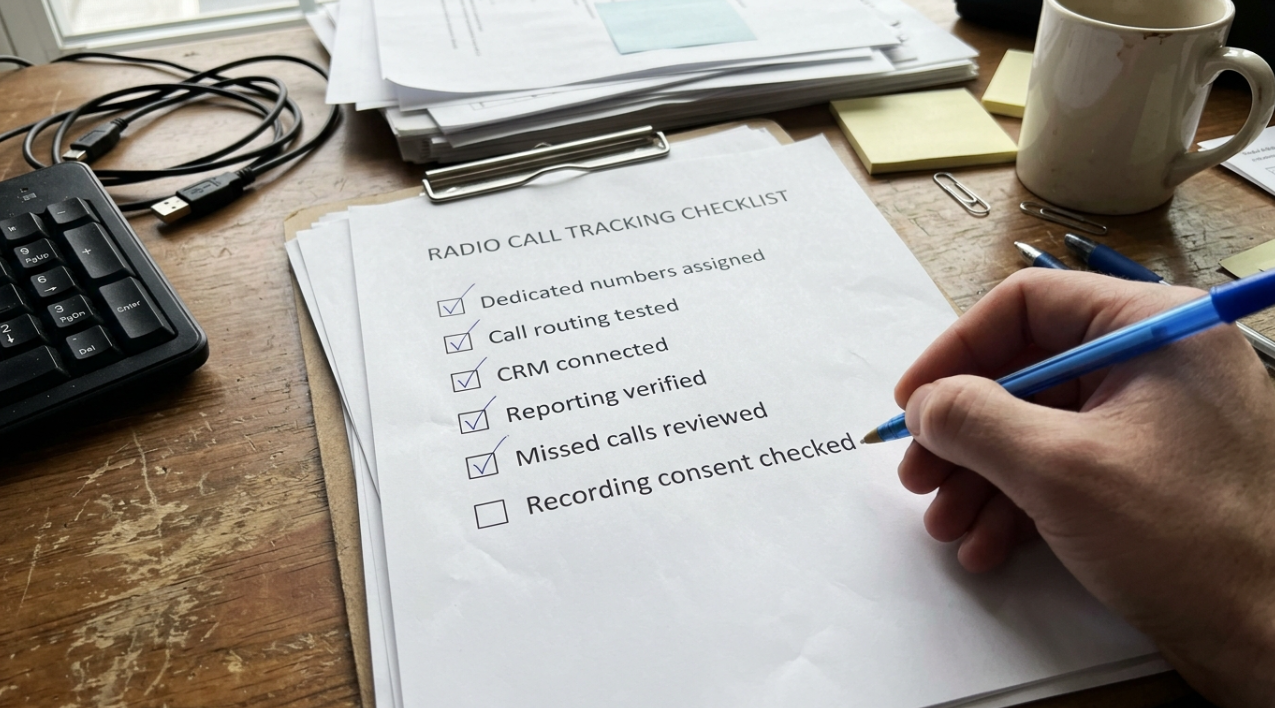
Pre-launch checklist: Every number has a documented source, calls reach the correct destination, reporting has been tested, CRM outcomes are defined, and the team knows how to handle missed calls and recording consent.
How Many Tracking Numbers Do You Need for Radio Ads?
The number of tracking numbers you need depends on how precisely you want to attribute calls. Assign a separate number to each source you intend to evaluate independently, but use as-run logs and campaign timing to investigate individual airings.
Measurement goal | Recommended setup | What it tells you |
|---|---|---|
Measure radio as one channel | One dedicated radio number | Overall tracked direct response from radio |
Compare radio stations | One number per station | Which station’s assigned number generated calls |
Compare radio platforms | Separate numbers for AM/FM, satellite radio, and streaming audio | How tracked responses differ by platform |
Test different commercials | One number per creative version, where practical | Which version generates more tracked calls |
Compare geographic markets | Separate numbers per market | Where calls are being generated |
Investigate individual airings | Station-level numbers plus as-run logs and call timestamps | Which airings coincide with response spikes |
Example: Choosing a Number Structure
Suppose you advertise on three radio stations across two markets and run two commercial versions.
If your priority is comparing stations, start with a separate tracking number for each station. If you also need to compare creative versions, use distinct numbers for each station-and-creative combination where practical, or use a controlled schedule that lets you isolate the versions.
More numbers are not automatically better. Choose a structure that answers your actual business questions without creating unnecessary cost or operational complexity.
CallTrackingMetrics recommends assigning one tracking number per offline source you want to evaluate separately. The same principle applies to radio: every placement you want to judge independently gets its own number.
For advertisers running across SiriusXM and terrestrial radio simultaneously, satellite and AM/FM response should be counted apart rather than pooled. If you plan to decide whether to keep or cut a station, one shared number across all stations will not give you that answer.
Practitioners on Reddit confirm this approach. In one radio discussion, a user described seeing local clients in a top-10 market use dedicated phone numbers for each media outlet, while also agreeing that repeating a number in a spot is a waste if it is not doing measurement work.
What Should a Radio Call Tracking Report Include?

A radio call tracking report should show not only how many calls a campaign generated, but also whether those calls became qualified leads, appointments, customers, or revenue. The right report separates call activity from lead quality and business outcomes.
Reporting category | Metrics to include | Why it matters |
|---|---|---|
Call volume | Total calls and unique callers | Shows how much direct response was recorded |
Call handling | Answered calls, missed calls, and response time | Identifies missed opportunities and intake problems |
Lead quality | Qualified calls, unqualified calls, and existing customers | Separates prospects from other callers |
Sales outcomes | Appointments, completed sales, and revenue | Connects calls to business results |
Efficiency | Cost per qualified call and cost per sale | Helps compare campaign performance against cost |
Attribution | Station, market, platform, creative, and call timestamp | Connects calls to the relevant media source |
Customer experience | Repeat callers, complaints, and unresolved inquiries | Highlights issues that raw volume cannot reveal |
Define each metric before launch. For example, decide what qualifies as a qualified call, how repeat callers are counted, and whether cost calculations include media spend alone or additional campaign costs.
Call duration can help identify calls worth reviewing, but it should not determine lead quality on its own. A long conversation may be a complaint, while a short call may result in a booking.
Radio-Specific Reporting Dimensions
Where the data is available, break results down by:
Station and geographic market.
Daypart, program, and actual airing time.
Host endorsement versus recorded commercial.
Platform, such as terrestrial radio, satellite radio, or streaming audio.
Creative version and offer.
Calls immediately following airings versus delayed response.
Use these breakdowns to identify patterns worth investigating, not to assume that every spike was caused by one particular airing.
This level of granularity turns call tracking from a count into a buying tool. It tells you what to change next in a radio schedule and where to shift weight.
Example: How to Measure Results From a Radio Campaign
Suppose a local business spends $6,000 on a radio campaign and uses a dedicated tracking number. At the end of the campaign, its report shows the following results.
Metric | Illustrative result |
|---|---|
Radio media spend | $6,000 |
Total tracked calls | 120 |
Unique callers | 100 |
Qualified calls | 40 |
Booked appointments | 20 |
Completed sales | 10 |
Revenue attributed to those sales | $15,000 |
These figures illustrate how to move from call volume to business outcomes. They do not represent typical or expected campaign performance.
Calculate Cost Per Qualified Call
Divide the radio media spend by the number of qualified calls.
$6,000 ÷ 40 = $150 per qualified call
This tells the advertiser how much media spend was associated with each qualified call recorded by the tracking system.
Calculate Cost Per Sale
Divide the media spend by the number of completed sales attributed to the campaign.
$6,000 ÷ 10 = $600 per sale
This metric is more useful than cost per call when the business goal is customer acquisition.
Calculate Return on Ad Spend (ROAS)
Divide attributed revenue by advertising spend.
$15,000 ÷ $6,000 = 2.5x ROAS
For every $1 in radio media spend, the campaign generated $2.50 in attributed revenue under this example’s attribution method.
ROAS is not the same as profit or ROI. It does not account for product costs, fulfillment, labor, agency fees, or other expenses unless those costs are included in the calculation.
How Should You Interpret These Results?
Do not judge a station solely by its call volume. Compare qualified calls, cost per sale, revenue, and the quality of the resulting customers. Also document whether revenue was directly linked to tracked calls or estimated through a broader attribution model.
For a fair comparison, use consistent qualification rules, equivalent reporting periods, and comparable cost definitions across stations.
Why Tracking Numbers Do Not Measure the Whole Radio Campaign
This is the point most competitor articles miss entirely. A tracking number captures direct response from people who dial the number they heard in the spot. It does not capture everyone influenced by the ad.
Many listeners hear a commercial while driving, remember the brand later, search the company name, visit the website, and call the main number. Others call from a Google Business Profile or map listing. That response may have come from radio, but it will not appear under the radio tracking number. CallFlux explicitly warns that tracking numbers do not capture every offline ad response because some people search the business and call from the website instead.
If the tracking number shows twenty calls, that does not mean radio only influenced twenty people. It means twenty callers used the response path you could measure cleanly.
A good radio measurement plan also looks at branded search lift, direct website traffic, form fills, and calls to the main number during the flight compared with a pre-campaign baseline. For a deeper framework, see how to measure radio advertising ROI.
Think of it as two layers:
Clean signal: The call through the dedicated tracking number. You know exactly which number was dialed, which station it was assigned to, when the call happened, whether it was answered, and whether it became a sale.
Full effect: All response influenced by radio, including branded search lift, direct website traffic, main-line calls, map listing calls, form fills, and delayed calls after repeated exposure.
A tracking number gives you the cleanest radio response signal. It does not give you the whole effect of radio. A complete measurement plan uses tracking numbers for direct response and baseline analysis for the delayed response radio creates.
How to Measure Radio Response Beyond the Tracking Number
To estimate the wider effect of radio advertising, monitor several signals alongside direct tracked calls.
Signal | What to monitor | Important limitation |
|---|---|---|
Tracked calls | Calls to dedicated radio numbers | Misses listeners who call through other numbers |
Main-line calls | Call volume to your usual business number | Other marketing and normal demand can influence volume |
Branded search | Searches for your business name during the campaign | A change does not establish that radio caused it |
Direct website traffic | Changes in direct visits and relevant landing-page activity | Analytics may classify some visits inaccurately |
Forms and online leads | Submissions during and after the radio flight | Visitors may have encountered other campaigns |
CRM outcomes | Qualified leads, appointments, sales, and revenue | Attribution depends on reliable records and consistent rules |
Use a Baseline to Interpret Changes
Record the same metrics for a suitable pre-campaign period, then compare them with the campaign period. Account for differences in weekday patterns, seasonality, promotions, other media activity, and business hours.
Where feasible, use a matched market or a holdout period to help estimate incremental lift. Keep the method consistent and document its limitations.
The goal is not to assign every inbound action to radio. It is to combine directly tracked response with additional evidence to build a more complete picture of campaign performance.
Static Tracking Numbers vs Dynamic Number Insertion
Static numbers and dynamic number insertion solve different problems.
Static tracking number: A fixed number assigned to a radio commercial, billboard, print ad, or other offline placement. The number does not change between listeners or viewers. Altcraft’s call tracking glossary describes static tracking as assigning each channel or campaign its own permanent number.
Dynamic number insertion (DNI): A website script that swaps the displayed phone number based on the visitor’s traffic source. A visitor from Google Ads sees one number, a visitor from organic search sees another.
Radio uses static numbers because the number is spoken once to many listeners. But if radio also drives listeners to search and visit your website, dynamic number insertion on the site can capture that secondary response. A serious radio campaign may need both.
Radio Call Tracking Methods Compared
Method | Best use | Main limitation |
|---|---|---|
Static tracking numbers | Attributing calls to radio stations, campaigns, and other offline placements | Only identifies calls made to the assigned number |
Dynamic number insertion (DNI) | Tracking calls from website visitors according to eligible traffic-source rules | Does not directly identify listeners who call the number spoken in a radio ad |
Call logs and recordings | Reviewing call handling, caller intent, and lead quality | Require appropriate access controls and recording compliance |
CRM matchback | Connecting calls to appointments, customers, and revenue | Depends on accurate records and consistent lead identification |
As-run logs and timestamp analysis | Comparing call timing with actual radio airings | Timing alone cannot prove which airing caused a call |
Baseline or market-lift analysis | Estimating broader response beyond tracked numbers | Requires a suitable comparison method and consideration of other influences |
These methods work best together. Static numbers capture a direct response path, while website analytics, CRM data, and baseline analysis help investigate additional effects that a single tracking number cannot reveal.
Radio Creative Best Practices for Call Tracking
Including a phone number in a radio spot costs airtime. That airtime only pays off if the number is easy to hear, easy to remember, and connected to a tracking system.
Practitioners on Radio Sales Café have debated for years whether phone numbers belong in radio spots at all. One practitioner argues that using more than one number in a spot loses the listener. Another says if a phone call is the desired action, the number belongs in the ad and should appear often. The consensus: if you include a number, use one number, make it easy to hear, and make the call to action worth the airtime it consumes.
Berk Marketing’s direct-response radio approach follows a defined structure: introduce the offer, develop it, repeat it, repeat it again, then give the call to action slowly and clearly two or three times at the end. The CTA comes when the listener is ready to respond, not before they understand why they should.
Key principles:
One number per spot. Do not crowd the ad with multiple phone numbers, websites, and addresses.
Plain toll-free numbers over vanity numbers. Berk Marketing’s practice is to favor a plain toll-free tracking number, delivered slowly and clearly, because the number has to work in the listener’s ear and in the reporting system.
Match the number to the tracking plan before production. Changing numbers after launch creates reporting gaps.
Repeat the CTA. Say the number two or three times at the end.
For guidance on how ad length affects CTA delivery, a 60-second spot generally provides enough room to develop the offer and deliver the phone number clearly. A 15-second spot rarely does.
Common Mistakes When You Track Calls From Radio Ads
Using one number across every station when station-level decisions are needed. If you cannot tell which station drove the calls, you cannot optimize the buy.
Changing the tracking number mid-flight. This splits your data and makes week-over-week comparison unreliable.
Putting the tracking number on the website, print ads, and radio at the same time. If the number appears in multiple places, you cannot attribute the calls to radio alone.
Counting every call as a lead. Wrong numbers, existing customers, and unqualified inquiries inflate your count.
Ignoring missed calls. A campaign may be generating response that your team is not picking up.
Ignoring repeat callers. Ten calls from the same person are not ten leads.
Using call duration as the only quality metric. A long call can be a complaint. A short call can be a booked appointment.
Relying on “How did you hear about us?” Practitioners on Reddit report that when call-heavy clients refuse tracking numbers, attribution falls back to “the phone rang more this month,” with callers or reps guessing whatever source is easiest. Ask the question if you want, but do not build the campaign around memory and guesswork.
Recording calls without checking consent requirements. Federal and state call recording laws vary, and when calls cross state lines, compliance can require consent from all parties. Justia’s 50-state survey covers the differences. If calls may contain health, legal, financial, or other sensitive data, confirm consent and compliance requirements before launch.
Pooling SiriusXM, terrestrial radio, streaming audio, and TV into one number. These are different platforms with different audiences, different reach patterns, and different cost structures. They deserve separate measurement.
Request a Free Competitive Report to see what stations and channels your competitors are running on before you build your tracking plan. No cost, no obligation.
Radio Call Tracking Troubleshooting: Common Problems and Fixes
If a radio campaign appears to generate few calls, check the tracking setup before concluding that the media buy is ineffective.
Problem | What to check | Recommended action |
|---|---|---|
No calls appear in the report | Number activation, call routing, and reporting filters | Test the number and verify the provider’s call records |
Calls arrive but are not answered | Staffing, business hours, and forwarding rules | Review call handling and after-hours arrangements |
Several stations share one number | Number assignment and campaign documentation | Use separate numbers for future tests when station-level attribution is needed |
Call volume increases but sales do not | Lead qualification and CRM disposition | Review call outcomes and lead quality |
Calls spike without an obvious airing | As-run logs, other marketing activity, and time zones | Reconcile the timing and investigate alternative explanations |
Website calls appear unrelated to radio | Website number replacement and analytics configuration | Audit dynamic number insertion and tracking rules |
Reports contain duplicate or repeat callers | Deduplication rules and caller identification | Define consistent rules for unique callers and repeat interactions |
Investigate the measurement system before changing the media schedule. Low tracked-call volume can reflect weak response, a technical issue, poor call handling, or listeners using another response path. Each possibility requires a different solution.
As-Run Logs and Call Timing
For larger or more serious campaigns, call tracking should be paired with the as-run log (also called a postlog). Quality Analytics describes radio call attribution as combining postlogs, which record every airing by time, station, market, and creative, with call data timestamped by the tracking provider.
A tracking number tells you which number was dialed. The as-run log tells you when each spot actually aired. Together, they reveal whether calls rise after specific stations, programs, dayparts, or creative versions. This is especially useful when multiple stations share a market and you need to understand which one is actually driving response.
For a complete guide to reading schedules and postlogs, see how to read a radio advertising schedule.
CRM Matchback: From Calls to Sales
Call tracking should not stop at “calls.” A call is not automatically a lead. A lead is not automatically a sale. Radio should be judged on qualified calls, booked appointments, consultations, applications, revenue, or another real business event.
CRM disposition is the bridge between call tracking and ROI. When the intake team tags each call as qualified, unqualified, booked, or closed, you can calculate cost per qualified call, cost per sale, and revenue by station or platform. Without that step, you are measuring activity, not outcomes.
For more on connecting tracked calls to revenue, see how to attribute leads from radio ads to sales.
Related Terms
Static tracking number: A fixed phone number assigned to one offline campaign or placement.
Dynamic number insertion (DNI): Website technology that swaps displayed numbers based on traffic source.
Direct-response radio: Radio advertising designed to produce a measurable immediate action, usually a phone call or website visit.
As-run log / postlog: A record of every spot that actually aired, by station, time, and creative.
Call routing: Forwarding a tracking number to a business’s existing phone line or call center.
Whisper message: A brief audio prompt the call agent hears before connecting, identifying the tracking source.
Call disposition: The outcome tag assigned to a call (qualified, unqualified, booked, sold).
Unique caller: A distinct phone number in the call log, counted once regardless of repeat calls.
Qualified call: A call meeting the advertiser’s predefined criteria for a real prospect.
Branded search lift: The increase in searches for the advertiser’s brand name during a radio flight, compared to a pre-campaign baseline.
Cost per qualified call: Media spend divided by the number of calls that met qualification criteria.
Station-level attribution: Tracking which individual radio station generated each call or lead.
Platform-level attribution: Tracking whether calls came from terrestrial radio, SiriusXM, streaming audio, or television.
Frequently Asked Questions
Can you really track calls from radio ads?
Yes. The standard method is assigning a dedicated static tracking number to each radio campaign, station, or platform. Major call tracking providers including CallRail, CallTrackingMetrics, and CallFlux all describe offline tracking numbers as the method for radio. The number forwards to your normal business line while the system logs every call. The limitation is that not every listener influenced by the ad will dial the tracking number. Some will search your brand later and call from a different source.
Do I need a different number for every radio station?
Only if you need station-level results. If you are deciding which station to keep, cut, or expand, one shared number cannot give you that answer. If you only need to measure radio as one channel alongside digital and TV, a single radio number may be sufficient. Match the number setup to the decision you plan to make.
Should radio ads use a vanity number or a plain toll-free number?
There is a real trade-off between memorability and attribution clarity. A vanity number may be easier to recall, but it can be harder to differentiate across channels. Berk Marketing’s practice is to favor a plain toll-free tracking number, delivered slowly and clearly, because the number has to work in the listener’s ear and in the reporting system.
Is asking “How did you hear about us?” enough to track radio calls?
No. It can supplement call tracking, but it should not replace it. Callers forget, guess, or give the most convenient answer. Sales reps forget to ask. One PPC practitioner on Reddit described the result when clients refuse tracking numbers: reporting collapses to “the phone rang more this month.” Use tracking numbers and call logs as the primary attribution method.
Can radio be measured like digital advertising?
Not exactly, but it can be measured well. Radio cannot produce click-level attribution because listeners hear a spot in the car or at work and may respond minutes, hours, or days later. RAB data shows 44% of AM/FM listening happens in the car and 19% at work. A good radio measurement plan accounts for both immediate and delayed response by pairing tracking numbers with baseline lift analysis, branded search data, and CRM outcomes.
What is the difference between static call tracking and dynamic number insertion?
Static call tracking assigns a fixed number to an offline placement like a radio spot. That number does not change between listeners. Dynamic number insertion is a website technology that swaps the displayed number based on how the visitor arrived. Radio uses static numbers because the phone number is spoken once and heard by everyone. If radio drives website visits, dynamic number insertion on the site can capture that secondary response.
How do I connect radio calls to actual sales?
By tagging call outcomes in your CRM. When the intake team marks each call as qualified, unqualified, booked, or closed, you can calculate cost per qualified call and cost per sale by station, platform, or creative. Without CRM disposition, you know how many times the phone rang but not whether those calls turned into revenue.
How Much Does Radio Call Tracking Cost?
The cost depends on the tracking provider, number of tracking numbers, call volume, recording requirements, integrations, and reporting features. Some plans charge a recurring subscription, while others may include usage-based fees or additional charges for specific features. Compare the total cost of the tracking system with the reporting detail you need before selecting a provider.
How Long Should You Track Calls From a Radio Campaign?
Track calls throughout the campaign and continue monitoring for a reasonable period after it ends, because some listeners respond later. The appropriate observation window depends on the offer, purchase cycle, audience, and frequency of exposure. Establish a consistent pre-campaign baseline and post-campaign window, and use the same rules when comparing stations or campaign periods.
Berk Marketing’s Approach to Radio Call Tracking
Berk Marketing represents advertisers, not stations. The agency holds no inventory and has no station it is obliged to recommend. Peter Berk, who has been in radio since 1978 and has been independent since 1999, is the client’s point person in almost every case. Work is not handed to a junior buyer after signing.
Tracking is agreed before launch, not patched together afterward. The agency assigns separate tracking numbers per station and per platform, so terrestrial radio, SiriusXM, streaming audio, and television response are counted independently. Commercial writing and production are handled in house, with the call to action and tracking number built into the script from the start.
That matters because talking to a station seller first can limit agency representation. Advertisers get the most value from an independent buyer before the first quote arrives.
Request a Free Competitive Report to see which stations and channels your competitors are running on, and how heavily. No cost, no obligation. Or call (866) 747-4707 and speak with Peter Berk directly.
Request a free radio media plan
Tell us who you want to reach and what you want to accomplish. No obligation, and nothing is placed until you approve it.
Ready to plan your radio buy?
Berk Marketing represents advertisers, not radio stations or media companies.