
Reviewed by Peter Berk, President and Chief Media Strategist, Berk Marketing · Last updated 1 October 2026
TLDR
A radio media buyer purchases advertising on behalf of the advertiser, while a radio sales rep sells advertising inventory on behalf of a station, network, or media owner. The buyer can compare competing stations and negotiate across the market; the sales rep is responsible for selling their own inventory. The difference is who each professional represents, not whether either role is capable or trustworthy.
Quick takeaway: If you want an independent comparison of stations, formats, pricing, frequency, and post-buy performance, speak with a media buyer before requesting station proposals. If you already know which station you want and can evaluate the schedule yourself, buying directly from its sales representative may be appropriate.
The U.S. Census NAICS classification draws the line cleanly. Media buying agencies are classified as establishments that purchase advertising time or space on behalf of clients. Media representatives, including radio advertising representatives, are classified as establishments that sell time or space for media owners. Same industry, opposite sides of the table.
One rule that catches advertisers off guard: if you want independent representation, the time to contact a buyer is before you ask stations for quotes. Once a seller has opened the account and provided a number, the independent buying route has usually closed. More on that below.
Media Buyer vs Radio Sales Rep: Quick Comparison
Question | Radio Media Buyer | Radio Sales Rep |
|---|---|---|
Who do they represent? | The advertiser | The station, network, or media owner |
What do they sell? | Buys advertising inventory for the client | Sells the station’s or network’s advertising inventory |
Can they compare competing stations? | Yes | Generally limited to their own station or media group |
Can they recommend not buying a particular station? | Yes | Their role is to sell their available inventory |
Who negotiates pricing? | Negotiates with multiple media sellers on the advertiser’s behalf | Negotiates the station’s available inventory and terms |
Who handles post-buy issues? | May monitor delivery, affidavits, preemptions, makegoods, and credits across the buy | Handles issues involving their station’s schedule |
Main advantage | Cross-market comparison and advertiser-side negotiation | Detailed knowledge of one station’s audience, programming, inventory, and promotions |
Best fit | Multi-station, multi-market, comparison-heavy, or measurement-focused campaigns | Advertisers that already know which station they want and can evaluate the proposal themselves |
Key question to ask | “Who do you represent, and what media can you recommend?” | “What can this station deliver for my campaign objective?” |
What Is a Radio Media Buyer?

A radio media buyer is a person or agency that purchases advertising airtime on behalf of an advertiser. Unlike a station sales representative, the buyer can evaluate multiple stations, formats, markets, and platforms before recommending where the advertiser’s budget should go.
A radio media buyer may handle station research, audience and ratings analysis, avails, rate negotiations, scheduling, frequency planning, added value, preemptions, makegoods, affidavits, invoice reconciliation, and post-campaign performance analysis.
The key distinction is representation: the buyer’s client is the advertiser, while the station representative’s client is the media owner.
After the schedule is placed, the buyer’s work continues. A broadcast media buyer job listing from KC Ad Club describes responsibilities including reviewing avails and ratings, monitoring reach and frequency, tracking competitive activity, managing preemptions and missed spots, negotiating makegoods and credits, and reconciling invoices against affidavits and proof of performance.
The point is that buying does not end when the contract is signed. A serious radio media buying operation includes post-buy accountability, not just pre-buy negotiation.
What Is a Radio Sales Rep?
A radio sales rep is a salesperson who sells advertising inventory for a radio station, station group, network, or other media owner. The role may also be called an account executive, media consultant, or advertising sales representative.
A radio sales rep typically knows their station’s audience, programming, talent, promotions, available inventory, dayparts, and commercial opportunities in greater detail than an outside buyer. They can build proposals, explain available packages, coordinate creative services, and negotiate the terms available within their station or media group.
The structural difference is important: a sales rep can recommend solutions involving the inventory they sell, while an independent media buyer can compare that inventory with competing options.
The Bureau of Labor Statistics notes that companies typically set monthly sales quotas for these roles and that performance-based pay can make up a large portion of earnings. That is not an accusation. It is how the job is measured. A sales rep is paid to sell their station’s inventory, and that structural fact shapes every recommendation they make.
Media Buyer vs Media Planner: Are They the Same?
A media planner and media buyer can be different roles, although one person or agency may perform both functions. A media planner develops the media strategy: which audiences to reach, which channels to use, how much weight each channel should receive, and how the campaign should be structured. A media buyer turns that plan into actual media placements by evaluating inventory, negotiating rates and terms, placing schedules, and monitoring delivery.
Role | Primary responsibility | Typical question |
|---|---|---|
Media planner | Strategy and channel allocation | “Where should we advertise to reach this audience?” |
Media buyer | Negotiation and media placement | “Which inventory should we buy, at what terms, and how will we verify delivery?” |
Radio sales rep | Selling media-owner inventory | “How can our station meet this advertiser’s objective?” |
For smaller campaigns, the same agency or individual may handle both planning and buying. The important distinction is whether the professional is working for the advertiser or selling inventory for a media owner.
The easiest way to tell who represents whom: ask what they can say no to. A station rep can say no to a bad package on their station. An independent radio media buyer can say no to the station itself.
Why This Distinction Matters When You Buy Radio
When an advertiser confuses a media buyer with a radio sales rep, four things tend to go wrong.
Station choice narrows to one option. A rep can recommend their own station. That is their job. A buyer compares multiple stations, formats, and platforms because the buyer is not obligated to move anyone’s inventory. As one marketing agency put it, agencies work for the client, while account executives work for the media partner.
Negotiation loses its main lever. A buyer can move money elsewhere if terms are not right. A rep can only negotiate within their own inventory. The ability to walk away, or to shift budget to a competing station, is the buyer’s primary negotiating advantage. For more on what shapes rate discussions, see this guide on how to negotiate radio advertising rates.
Frequency gets set by budget instead of format. This is a point most comparisons miss entirely. News, talk, and sports listeners tend to be deeply engaged with spoken word programming, so a message can land with fewer spots per day on those formats. Music listeners may be tuned in but less attentive to every commercial break, requiring more frequency to build recall. A schedule that looks generous on paper can still fail if the weight was designed for one format but placed on another. Frequency should be set by format, listening behavior, market, and objective, not by budget alone.
Nobody checks whether the schedule actually ran. Amazon Ads describes the media buying process as including monitoring, reconciliation, and negotiating makegoods for under-delivery. Without someone performing that work, preempted spots can go unreplaced and credits can go unclaimed.
The Timing Rule: Talk to the Buyer Before the Seller
This is the single most important operational detail that most media buyer vs radio sales rep comparisons leave out.
If a station or network representative has already contacted an advertiser and quoted a number, the independent buying route may close. Berk Marketing, for example, does not take clients away from radio stations. Once a seller has opened the account and provided a quote, Berk Marketing generally cannot represent the advertiser on that account. The seller earned the relationship, and the agency respects that.
The practical implication: the point at which an independent buyer is most valuable is before the first seller conversation. After the first quote, the advertiser’s options narrow.
This is not a scare tactic. It is how the industry works. If you want someone comparing stations on your behalf, start with the buyer, not the station.
Should You Contact a Media Buyer or Radio Sales Rep First?
The right starting point depends on how much of the media decision has already been made.
Your situation | Practical starting point |
|---|---|
You want to compare several stations | Media buyer |
You are considering multiple formats | Media buyer |
You are comparing radio with streaming or other media | Media buyer |
You already know you want one specific station | Station sales rep |
You have an established relationship with a station | Station sales rep may be appropriate |
You need help negotiating across multiple stations | Media buyer |
You need someone to monitor delivery across several stations | Media buyer |
You only need information about one station’s inventory | Station sales rep |
You are unsure whether radio should be in the plan at all | Independent media buyer can provide a broader comparison |
If you want independent representation, contact the buyer before requesting station proposals. In some agency arrangements, once a station representative has established the account relationship and provided a quote, the agency may not be able to represent that account. That is an agency-specific policy, so advertisers should confirm the rule with the buyer before contacting stations.
When Buying Direct from a Radio Rep Makes Sense
A direct station relationship is a reasonable choice when:
The advertiser wants one station and knows why that station is right.
The station’s audience clearly matches the customer profile.
The account executive is trusted and the relationship is strong.
The campaign is local, straightforward, and not heavily dependent on measurable response.
The advertiser has internal media knowledge and can evaluate the schedule, terms, and delivery independently.
A LinkedIn practitioner guide on first-time radio buying makes a fair point: a sales representative can be a resource and adviser, but they are a poor surrogate for the advertiser’s own marketing judgment. In other words, even when buying direct, the advertiser still needs to evaluate whether the proposal serves their business or the station’s inventory goals.
If you are buying direct, understanding how to read a radio schedule is essential. Spots, dayparts, rotations, and preemption terms all affect whether a schedule actually delivers what the proposal promises.
When an Independent Radio Media Buyer Is the Better Fit
An independent buyer becomes more valuable when:
More than one station, market, or format is under consideration.
The campaign needs measurable direct response, not just awareness.
The advertiser is evaluating terrestrial AM/FM alongside SiriusXM, streaming audio, and television.
A competitive monitoring report would change the media plan. It usually does, even when it shows that competitors are not running.
The schedule needs enough frequency to work, and the required frequency depends on the format.
Preemptions, makegoods, and affidavits need to be checked professionally.
The advertiser needs someone who can recommend against a station, or against radio entirely.
Practitioners on Reddit describe the buyer role in terms that reinforce this distinction: buying radio or TV spots means working through reps and negotiating prices and schedules within a budget. A buyer does not replace station reps. A buyer manages and negotiates with them on the advertiser’s behalf.
How to Compare a Radio Advertising Proposal Before You Buy
A station proposal tells you what one media owner is offering. Before accepting it, compare the proposal against the campaign objective and, when possible, against competing media options.
Check these elements:
What to check | What to look for |
|---|---|
Target audience | Does the station’s audience match the people you need to reach? |
Format | Does the programming environment fit the campaign? |
Dayparts | When will the commercials run, and why were those times selected? |
Frequency | How often is the target audience expected to hear the message? |
Reach | How many people are expected to be reached? |
Cost | What is the total investment and effective cost of the schedule? |
Added value | Are bonus spots, promotions, digital placements, or other elements included? |
Preemption terms | What happens if scheduled spots do not air? |
Makegoods | What replacement inventory is provided for missed or under-delivered spots? |
Measurement | How will calls, leads, visits, sales, or other outcomes be tracked? |
Competitive context | What are comparable stations or competing advertisers doing? |
Contract terms | What cancellation, payment, renewal, and placement conditions apply? |
A low spot rate does not automatically make a schedule efficient. The relevant question is whether the complete schedule can deliver the audience, frequency, timing, terms, and measurement required by the campaign.
What a Media Buyer Does After the Schedule Runs
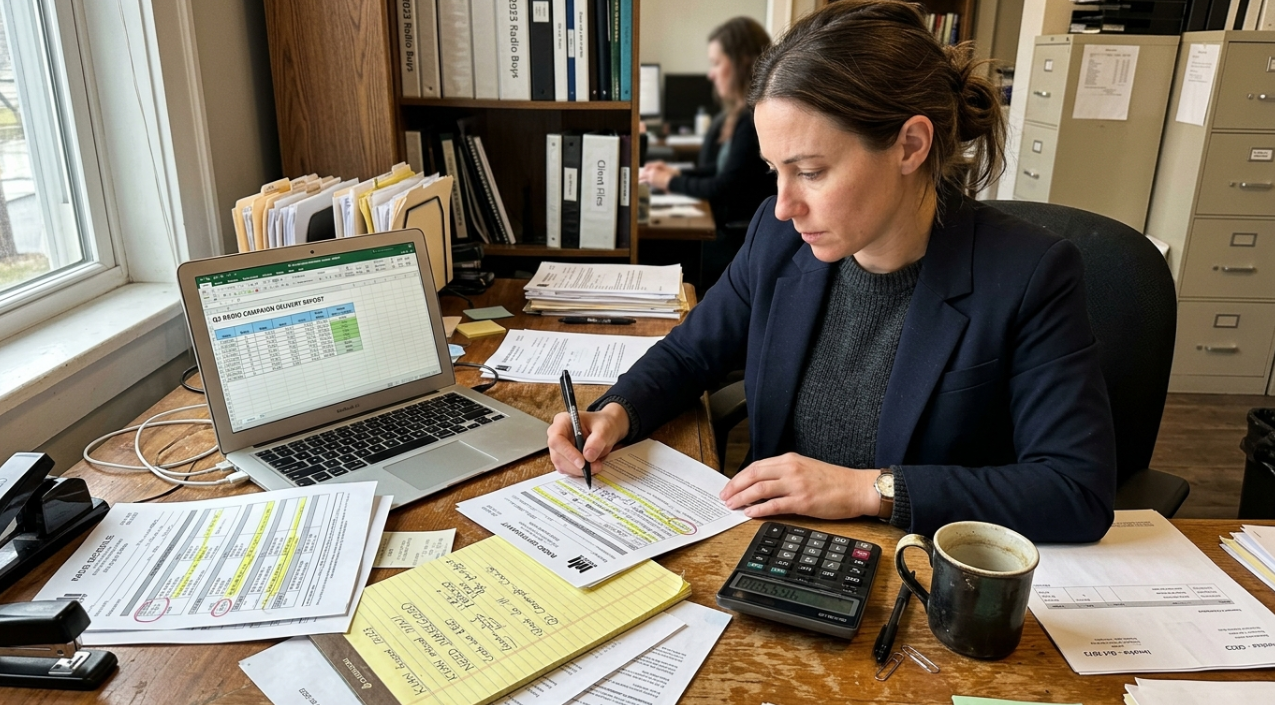
Most articles about the media buyer vs radio sales rep question focus on what happens before the campaign. The bigger differentiator is what happens after.
A media buyer’s post-buy checklist includes:
Confirming traffic instructions were followed and the correct creative aired.
Reviewing affidavits to verify what actually ran.
Identifying preempted spots and determining whether replacement airtime was comparable.
Negotiating makegoods or credits for missed or under-delivered placements.
Comparing response data by station and platform.
Recommending whether to cut, move, or increase budget on specific stations for the next flight.
Most advertisers think radio advertising involves two tasks: make the ad and buy the airtime. In practice, there are three jobs:
Choose the audience environment. Station, format, show, market, platform.
Negotiate and place the schedule. Price, daypart, frequency, terms, trafficking.
Protect the buy after it runs. Affidavits, preemptions, makegoods, credits, response data.
A radio sales rep handles all three inside their own station’s inventory. A media buyer performs those jobs across competing options. Designing lead attribution before launch is part of that third job, and it should be set up before the campaign starts, not after.
Common Misconception: “The Station Gave Me a Plan, So I Have a Media Plan”
A station proposal can be useful. It shows what that station offers, what inventory is available, and what the pricing looks like. But a station proposal is a proposal for that station’s inventory. It is not a market comparison. It does not prove that the station is the best use of the budget, and it does not show what competitors are doing on other stations or platforms.
Advertisers on Reddit express real skepticism about radio targeting and measurability. In one thread, a commenter pushed back that B2B advertisers should question radio if most listeners are not in the target audience, while another argued radio can work where businesses have radios playing, such as mechanic shops or restaurant kitchens. The takeaway is not that radio does or does not work. It is that a single station proposal cannot answer that question. Only a comparison across stations, formats, and platforms can.
Common Misconception: “A Buyer Just Gets a Lower Price”
Price matters. But buying only on price can waste money just as easily as overpaying. A weak schedule on a cheap station that does not reach the right audience is still a loss.
The right question is not “how cheap is each spot?” The right question is whether the schedule delivers the audience, frequency, placement, terms, and measurement needed for the campaign objective. A rate card is an opening position in a negotiation, not a final price. A buyer’s job is to compare the audience delivery and terms against the advertiser’s goal, then negotiate accordingly. For a deeper look at what shapes pricing, see this guide on how radio stations price ads.
How to Measure Whether Your Radio Advertising Worked
Radio campaign measurement should be defined before the schedule starts. The appropriate metrics depend on the campaign objective, but advertisers can generally separate measurement into four levels.
Measurement level | Example metrics | When it matters |
|---|---|---|
Delivery | Spots aired, reach, frequency, preemptions, makegoods | Every campaign |
Response | Calls, website visits, QR scans, promo codes, form fills | Direct-response campaigns |
Sales | Leads, appointments, purchases, revenue | Performance-focused campaigns |
Brand | Awareness, recall, search activity, consideration | Brand-building campaigns |
For direct-response campaigns, assign tracking methods before launch. These can include dedicated phone numbers, landing pages, promo codes, QR codes, campaign-specific URLs, or CRM source fields.
For brand campaigns, response data alone may not capture the full effect. Brand-lift surveys, search trends, direct traffic, and changes in awareness or consideration can provide additional evidence.
Post-buy measurement should also compare what was scheduled with what actually aired. Affidavits, delivery reports, preemption records, makegoods, and credits help establish whether the purchased inventory was delivered as agreed.
How Berk Marketing Fills the Buyer Role
Berk Marketing is an independent radio and television media buying agency. It represents advertisers, not stations. It holds no inventory, owns no airtime, and has no station it is obliged to recommend. That matters because a station account executive is paid to sell that station’s inventory. Berk Marketing’s job is to compare whether that station belongs in the plan at all.
Peter Berk has worked in radio since 1978 and founded the agency in 1999 after roughly two decades on the station side. He is a Certified Radio Marketing Consultant (certificate 589, issued by the Radio Advertising Bureau in December 1980) and serves as the client point person in almost every case. Work is not handed to a junior buyer after the contract is signed.
Hybrid Media Services, led by Kevin Mannix President and CEO of Hybrid Media Services, is the strategic partner behind the national buying operation. A competitive monitoring report, provided through Hybrid Media Services at no cost and no obligation, shows which stations and channels an advertiser’s competitors are running on and how heavily. In many cases the report shows nothing at all, which is itself a useful finding: it may reveal an open category or confirm that competitors are not applying pressure through radio.
The agency writes and produces commercials in house, sets up direct response tracking with separate numbers per station and platform, and plans frequency by format rather than by budget alone.
Request a Free Competitive Report. No cost, no obligation. Or call (866) 747-4707 and speak with Peter Berk directly.
FAQ
Is a radio sales rep the same as a media buyer?
No. A radio sales rep sells a station’s or network’s inventory. A media buyer purchases media on behalf of the advertiser. The sales rep works for the media owner. The buyer works for the advertiser. Both roles can involve knowledgeable professionals, but their obligations point in opposite directions.
Can a radio sales rep still give good advice?
Yes. A strong account executive knows their station’s audience, programming, promotions, and talent better than almost anyone. The limitation is structural: they cannot objectively recommend a competing station, even if that station would be a better fit for the advertiser’s campaign.
Does a media buyer replace the station rep?
No. The buyer works with station reps, network sellers, and other media vendors. The buyer manages the comparison and negotiation across those sources on the advertiser’s behalf. The station rep remains the point of contact for that station’s inventory.
Should I call stations first or a buyer first?
If you want independent representation, call the buyer first. Once a station or network seller has quoted you a number, an independent buyer like Berk Marketing generally cannot represent you on that account. The agency’s value is highest before the first seller conversation.
When is buying direct from a station the right choice?
When the advertiser wants one station, the audience match is clear, the account executive is trusted, the campaign is simple and local, and the advertiser can evaluate the schedule and track results internally.
What does a media buyer check after the campaign runs?
Delivery against the contract, affidavits, preemptions, makegoods, credits, response by station and platform, and whether the next flight should be adjusted. This post-buy work is a core part of the buyer’s job and one of the main reasons to use one.
How is an independent radio media buyer compensated?
At Berk Marketing, compensation is the standard media commission built into the buy, split with strategic partner Hybrid Media Services. There is no separate retainer and no fee for a media plan or competitive monitoring report.
What is the best question to ask when deciding between a media buyer and a radio sales rep?
Ask each one: “Who do you represent, and what inventory can you recommend?” A sales rep will name their station or group. A buyer should be able to recommend across the full market, including the option of not buying radio at all.
Request a free radio media plan
Tell us who you want to reach and what you want to accomplish. No obligation, and nothing is placed until you approve it.
Ready to plan your radio buy?
Berk Marketing represents advertisers, not radio stations or media companies.