Reviewed by Peter Berk, President and Chief Media Strategist, Berk Marketing · Last updated 27 September 2026
TL;DR
Disclosure: This page is published by Berk Marketing, an independent radio, TV and SiriusXM media buying agency. We are not in the ranking below, on purpose. Hybrid Media Services, which is in it, is Berk Marketing’s own negotiating partner. Weigh that entry with this in mind.
The best national radio advertising company depends on whether you need a buyer-side agency, a media network, or a national radio representation firm. Buyer-side agencies such as Hybrid Media Services, Ad Results Media, and RadioActive Media can help advertisers compare inventory and manage campaigns across multiple audio platforms. Networks such as iHeartMedia and Westwood One sell access to their own or affiliated inventory, while Katz Media Group represents radio inventory on behalf of media owners.
For smaller direct-response campaigns, prioritize companies that offer remnant inventory, production, call tracking, and flexible media buying. For podcast-heavy campaigns, look for agencies with host-read advertising and attribution capabilities. For large national brand campaigns, network reach, premium programming, sponsorships, and audience targeting may matter more than the lowest spot price.
There is no single “best” national radio advertising company for every advertiser. The right choice depends on your monthly media budget, target audience, campaign objective, desired level of scheduling control, and how you plan to measure results.
What Is the Best National Radio Advertising Company?
There is no single best national radio advertising company for every business. For direct-response advertisers seeking flexible buying and potentially discounted inventory, buyer-side agencies such as Hybrid Media Services and The Remnant Agency are worth evaluating. Ad Results Media and RadioActive Media are stronger fits for podcast and host-read campaigns, while iHeartMedia and Westwood One are better suited to advertisers seeking large-scale network reach and premium programming. Katz Media Group is a national media representation firm rather than an advertiser-side agency. Your best choice should be based on budget, audience, campaign objective, inventory access, attribution, and contract terms.
Best National Radio Advertising Companies at a Glance
Company | Business Type | Best For | Budget Level | Buying Model | Production | Attribution |
|---|---|---|---|---|---|---|
Hybrid Media Services | Buyer-side agency | High-volume direct-response audio | Mid–High | Multi-platform audio | Yes/Full service | Campaign measurement |
Ad Results Media | Buyer-side agency | Podcast and host-read campaigns | Mid–High | Podcast + radio + digital audio | Full service | Performance measurement |
Oxford Road | Buyer-side agency | Enterprise podcast and audio performance | High | Large-scale audio buying | Full service | Advanced attribution |
RadioActive Media | Buyer-side agency | Startups and growth-stage brands | Lower–Mid | Radio + podcast | Yes | Campaign measurement |
The Remnant Agency | Buyer-side agency | Multi-channel remnant buying | High | Remnant TV + radio + OOH + CTV | Full service | Varies |
iHeartMedia | Seller-side network | National reach through one media company | Varies | Owned/operated inventory | Varies | Varies |
Cumulus / Westwood One | Seller-side network | Sports, news and syndicated programming | Varies | Network inventory | Varies | Varies |
Katz Media Group | National rep firm | Agencies needing national station access | High | Represents media owners | No | Varies |
Important: Budget ranges should be treated as planning estimates unless the company publicly publishes a minimum. Ask each provider for its current media minimum, management fee, production fee, and cancellation terms before comparing proposals.
For a deeper breakdown of radio advertising costs and rates, check our dedicated pricing guide.
How We Evaluated These National Radio Advertising Companies
We evaluated these companies using the factors that matter most when choosing a national radio advertising partner:
Business model: Does the company buy media for advertisers, sell its own inventory, or represent media owners?
National reach: How much radio or audio inventory can the company access?
Campaign specialization: Does it focus on direct response, brand awareness, podcasts, sports, talk radio, or remnant inventory?
Budget fit: Is the company appropriate for smaller advertisers, growth-stage brands, or enterprise campaigns?
Creative support: Does the company provide scripting, voiceover, production, or host-read creative?
Measurement: Does it provide call tracking, attribution, conversion measurement, or other performance reporting?
Buying flexibility: Can advertisers compare multiple networks and stations, or are they primarily purchasing inventory from one media owner?
Transparency: Are pricing, minimums, fees, and campaign requirements publicly available?
Because media rates, audience measurements, inventory, and company offerings can change, advertisers should confirm current pricing and terms directly with each provider before signing a campaign agreement.
Buyer-Side Agency vs. Media Network vs. National Rep Firm
Type | Works Primarily For | What You Buy | Main Advantage | Main Limitation |
|---|---|---|---|---|
Buyer-side agency | Advertiser | Media buying and campaign management | Can compare inventory across providers | Agency fees and minimums may apply |
Seller-side network | Media owner/network | Network-owned or affiliated inventory | Large reach and premium programming | Limited to that network’s inventory |
National rep firm | Media owners | Access to represented stations | Simplifies national station access | Does not represent the advertiser’s interests |
Understanding the Three Types of National Radio Advertising Companies
Before picking a company from this list, you need to understand what kind of company you’re actually hiring. This is the single most important distinction most guides skip entirely, and it directly affects what you’ll pay and what kind of service you’ll get.
Buyer-side agencies work for you. They negotiate across competing stations, networks, and platforms to get the best rates and placements for your budget. They have no financial incentive to push one station’s inventory over another. Companies like Hybrid Media Services, RadioActive Media, and Ad Results Media fall into this category.
Seller-side networks own or syndicate radio inventory. iHeartMedia and Cumulus/Westwood One are the two giants here. When you buy directly from them, you’re buying their stations only. They can offer tremendous reach, but you won’t get cross-network negotiation leverage. Buying ad space directly often means paying a premium because the seller has no incentive to shop around on your behalf.
National rep firms like Katz Media Group sit in the middle. They represent thousands of individual stations, selling that inventory to national advertisers and agencies. They work for the stations, not for you.
Why does this matter? If you’re a direct-response advertiser looking for the best possible cost per lead, a buyer-side agency will almost always deliver more value than going directly to a network. The agency can compare rates across iHeart, Cumulus, independent stations, and SiriusXM simultaneously. The network can only sell you what it owns.
For advertisers interested in discounted unsold airtime, our guide to remnant radio advertising explains the economics in detail.
Is National Radio Advertising Still Effective in 2026?
Yes, but radio should be evaluated as part of a broader audio and media strategy rather than as a standalone channel.
Radio continues to provide substantial U.S. audience reach, while digital streaming, podcasts, and connected audio have expanded the number of ways advertisers can reach listeners. Nielsen’s 2026 audio research continues to show the importance of radio within the broader U.S. audio ecosystem.
Edison Research also reports that ad-supported sources account for 64% of daily audio listening among the U.S. population age 13+, although that category includes AM/FM radio and radio streams alongside podcasts, ad-supported streaming and other sources.
The practical takeaway is that advertisers should not ask only, “Does radio work?” A better question is: “Which audio format, audience, buying model, frequency level, and attribution method gives this campaign the best economics?”
The 8 Best National Radio Advertising Companies
1. Hybrid Media Services
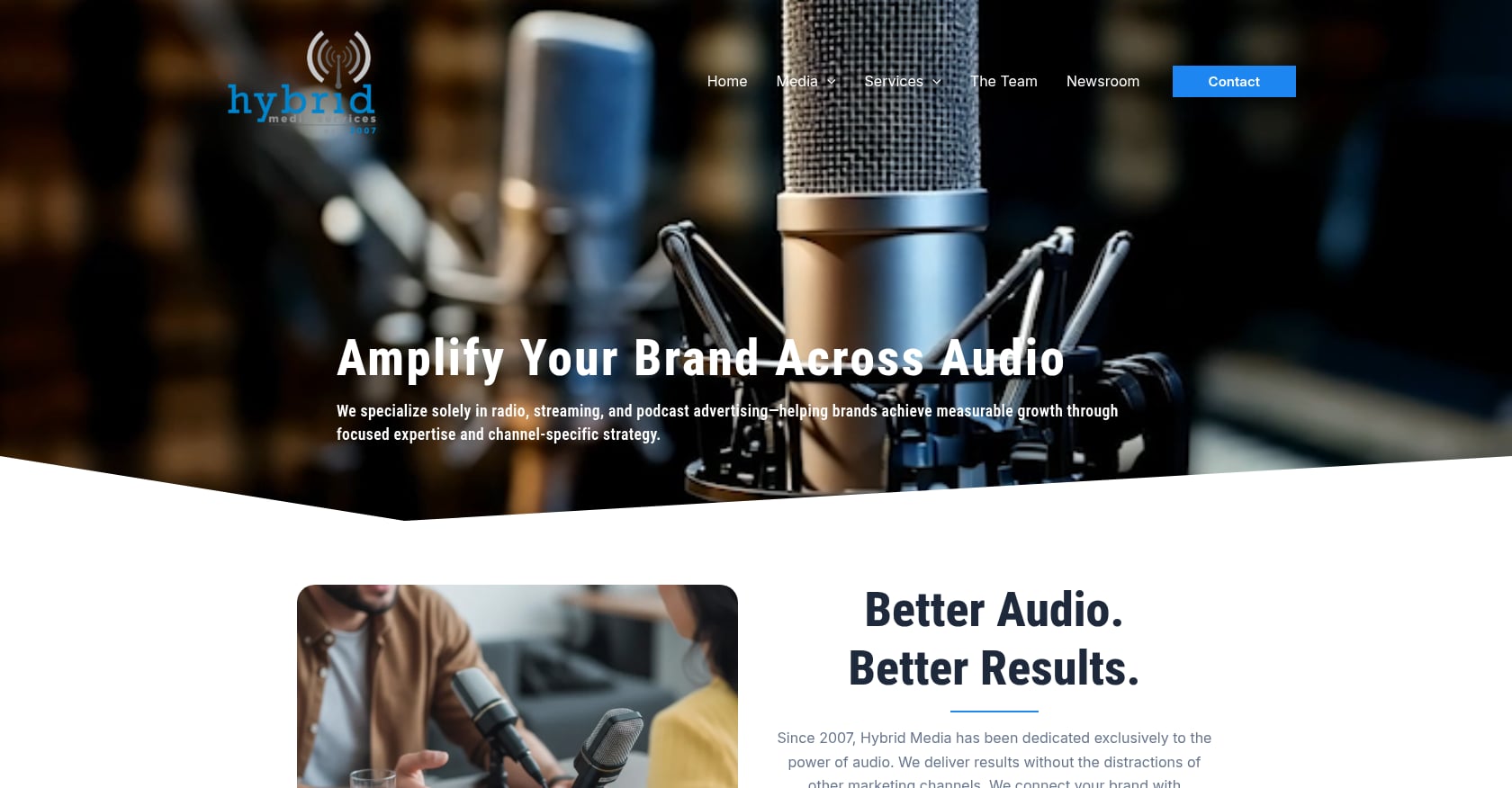
Best for: High-volume DR advertisers wanting a 100% audio-focused agency with massive buying power.
Founded in 2007, Hybrid Media Services has been dedicated exclusively to the power of audio for nearly two decades. The agency purchases millions of dollars in low-cost media every week, which gives clients significant rate advantages through aggregated buying power.
Key features:
Specializes in direct response radio, SiriusXM, streaming audio, and podcast campaigns
Bulk buying power drives rates down across all audio platforms
Full-service creative and media planning
Long track record with high-spend DR clients
Pricing: Not publicly disclosed.
Limitations:
Audio-only agency; no TV, out-of-home, or digital display capabilities
Less suited for brand-awareness campaigns that need visual components
Limited public information on pricing tiers or fee structures
Real-world signal: A testimonial from Wesley Financial Services states that Hybrid Media “has been instrumental in Wesley Financial Services becoming one of the largest timeshare cancellation companies in the country,” pointing to measurable business growth tied to their audio campaigns.
2. Ad Results Media (ARM)
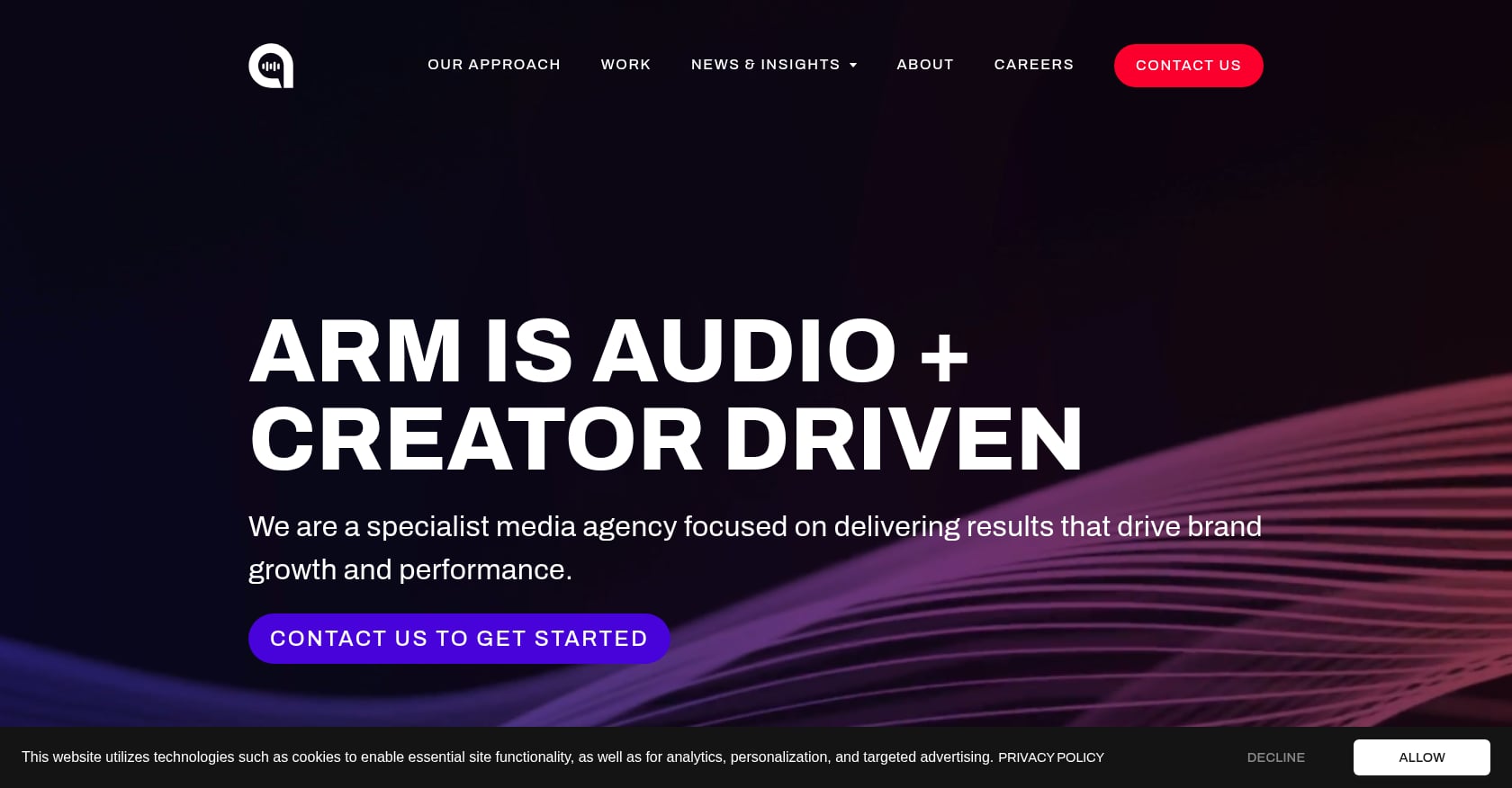
Best for: Brands wanting podcast, radio, and YouTube audio bundled with endorsement-style ads.
Ad Results Media calls itself the world’s leading audio-influencer agency, and with over 20 years in the space and offices in Houston, Austin, Los Angeles, San Diego, and Boston, the claim carries weight. ARM is a leading purchaser of podcast advertising globally and specializes in creating intimate, host-endorsed connections between audiences and brands.
Key features:
Podcast + terrestrial radio + YouTube audio buying under one roof
Expertise in host-read endorsement ads that build trust
20+ years of audio advertising experience
Multi-city presence for regional campaign coordination
Pricing: Not publicly listed.
Limitations:
Podcast-first orientation may not suit advertisers focused purely on terrestrial or talk radio
Glassdoor reviews (3.6/5 from 97 reviews) mention strong training but also concerns about workload management and staffing, suggesting rapid scaling has created some unevenness
Less focused on remnant or discount buying strategies
For advertisers specifically interested in host-read endorsements, this format works particularly well on talk and sports radio where listeners trust the host.
3. Oxford Road / Veritone One
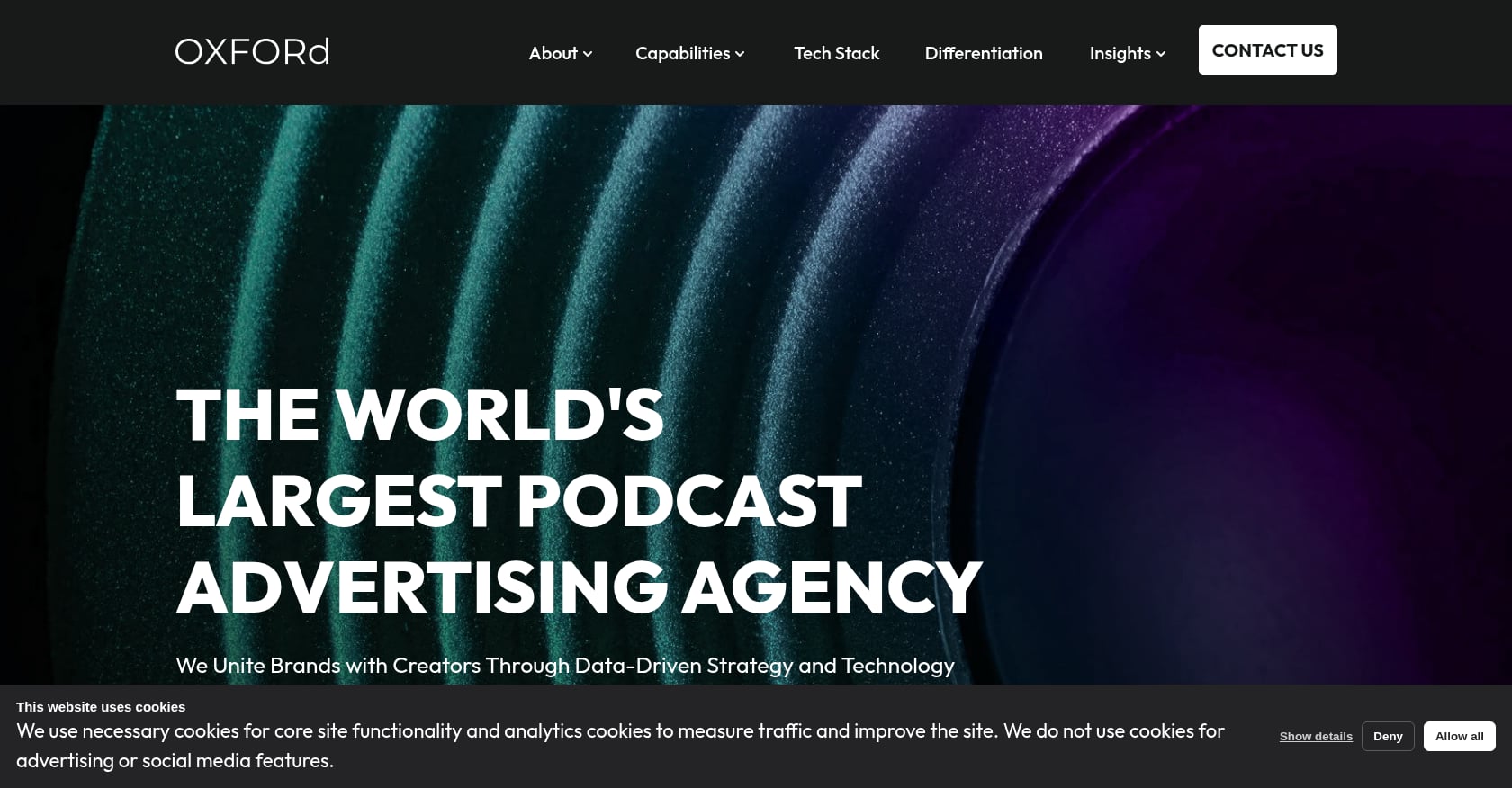
Best for: Enterprise and DTC brands needing massive-scale podcast and audio performance with proprietary attribution.
Oxford Road, now merged with Veritone One after Insignia Capital Group acquired both companies in a deal valued at up to $104 million, is the world’s largest podcast advertising agency. Their clients comprise half of the top podcast advertisers, and they place over 200,000 brand integrations annually. The agency handles host vetting, creative development, media buying, and attribution modeling through their proprietary Audiolytics platform.
Key features:
Largest podcast ad agency globally, with deep inventory access
Proprietary attribution modeling (Audiolytics) for measuring audio campaign performance
Full-service creative, from host vetting to script development
Track record of helping over a dozen startups scale into billion-dollar brands
Covers podcasting, streaming audio, terrestrial radio, and creator-based video
Pricing: Enterprise-oriented, and not publicly disclosed.
Limitations:
Not built for SMBs with $5,000–$10,000 budgets
Podcast-dominant focus means terrestrial radio may not receive primary attention
Post-merger integration could mean service model changes
4. RadioActive Media
Best for: Startups and small businesses wanting host-endorsed DR radio and podcast advertising.
Founded in 2008, RadioActive Media is an independent media planning, buying, and creative agency that specializes in working with small and startup companies. In 2024, Inc. Magazine recognized RadioActive Media as the #20 fastest-growing private company in the Pacific region, a strong signal of client results driving business growth.
Key features:
Startup-friendly approach with hands-on campaign management
Host-endorsed radio and podcast campaigns
Track record with notable brands including SolarCity, Squatty Potty, LogMeIn, and PhoneSoap
Covers both U.S. and Canadian markets
Pricing: Not publicly disclosed.
Limitations:
Smaller agency with narrower internal resources compared to ARM or Oxford Road
Less emphasis on remnant or discount buying strategies
May have capacity constraints during peak periods given smaller team size
5. The Remnant Agency
Best for: Multi-channel remnant buyers who want TV, radio, billboard, and CTV discounts through one agency.
The Remnant Agency positions itself as a full-service remnant ad agency with over 30 years of combined experience in the radio industry, including team members who have both bought media and owned/managed radio stations.
Key features:
Remnant buying across TV, radio, billboard, and CTV in one place
Full-service including targeting, production, and media buying
Deep radio industry experience from both buyer and station-owner perspectives
Pricing: Clutch lists a minimum project size of $50,000+, making this a higher-commitment option.
Limitations:
Higher project minimums put this out of reach for smaller budgets
Mixed public reviews (2 stars on Birdeye from 4 reviews), though the small review sample makes this hard to evaluate conclusively
Radio is not the exclusive focus; attention may be split across multiple media types
If you’re comparing remnant strategies specifically, understanding how to negotiate last-minute airtime rates can help you evaluate what any remnant agency should be doing on your behalf.
6. iHeartMedia
Best for: Brands wanting maximum national radio reach through a single media company.
iHeartMedia is the largest radio company in the United States, owning over 860 radio stations across the country. iHeartRadio, their digital platform, has over 188 million registered users and is available on more than 500 platforms. The company also operates one of the largest podcast networks in the world.
Key features:
860+ owned radio stations providing true national coverage
iHeartRadio digital platform extends reach to streaming listeners
Podcast network for cross-platform audio campaigns
Major event sponsorship opportunities (iHeartRadio Music Festival, etc.)
Pricing: Highly variable by market, format, and daypart. Major market drive-time inventory sits at the top of the range and smaller markets at the bottom.
Limitations:
Seller-side: you’re buying iHeart inventory only, with no cross-network negotiation
Direct buying typically means paying closer to rate card prices
Massive company where smaller advertisers may not receive priority attention
Important distinction: iHeart is a media owner, not a buyer-side agency. Working with them is like buying a car from the dealership. Working with a buyer-side agency is like hiring someone to shop every dealership for you.
7. Cumulus Media / Westwood One
Best for: Advertisers wanting to align with premium nationally syndicated sports and news content.
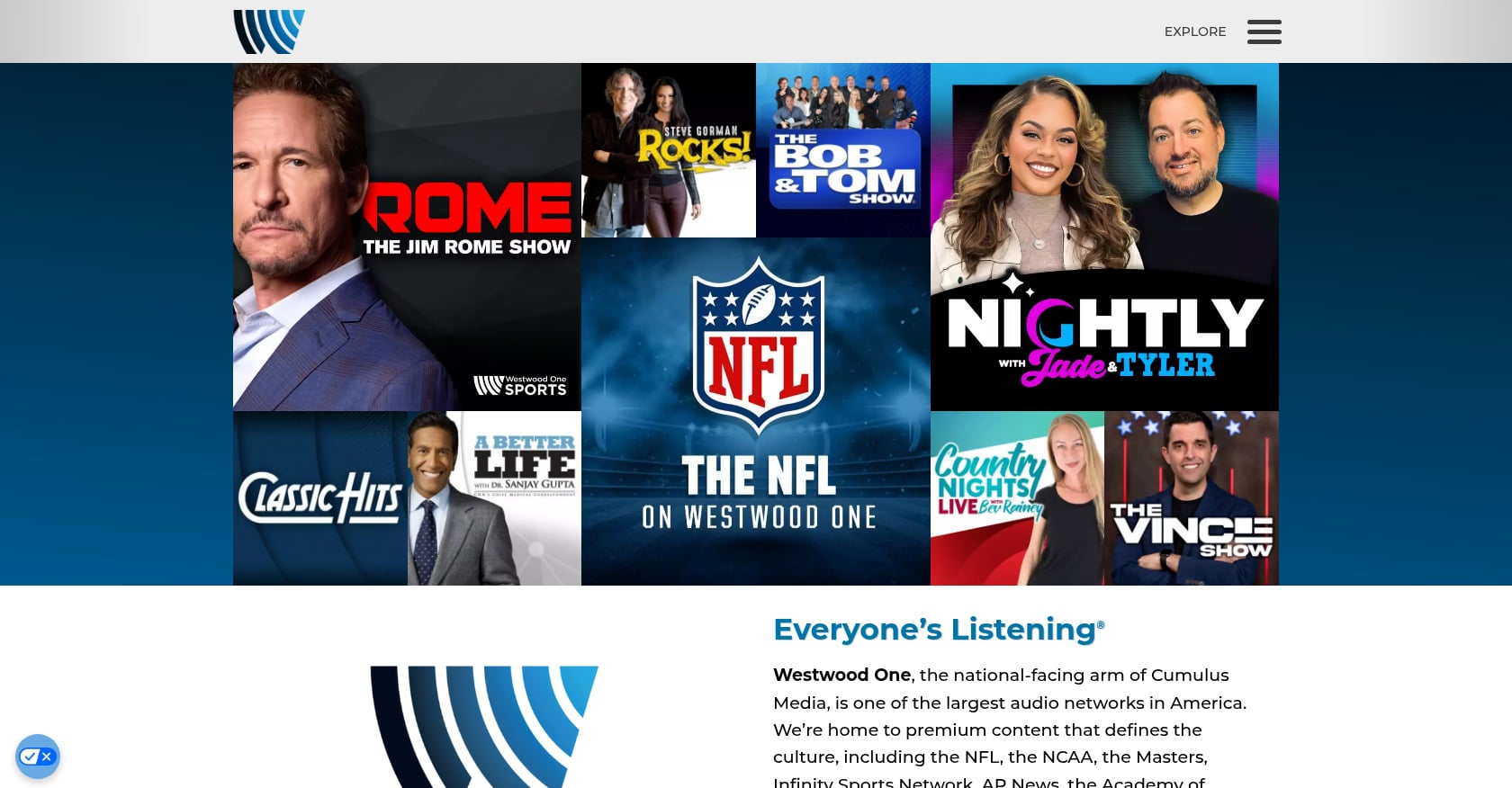
Westwood One, the national-facing arm of Cumulus Media, is one of the largest audio networks in America. It delivers nationally syndicated sports, news, and entertainment content to 245 million listeners weekly across 9,800 affiliated broadcast radio stations.
Key features:
Exclusive national broadcast rights to NFL, NCAA, Masters, and other premium sports properties
9,800 affiliated stations for massive national distribution
Combined local (Cumulus station group) and national (Westwood One) buying options
News and talk programming with loyal, engaged audiences
Pricing: Custom, based on program alignment and schedule. Premium sports adjacencies command higher CPMs.
Limitations:
Seller-side, with the same cross-network negotiation limitations as iHeart
Cumulus has navigated financial challenges, including a previous bankruptcy, which may affect long-term stability perceptions
Premium content placements (NFL, NCAA) carry premium prices
For advertisers interested in nationally syndicated talk radio, Westwood One’s network is one of the primary distribution channels.
8. Katz Media Group
Best for: Large national advertisers or agencies needing a single point of contact for 3,500+ radio stations.
Founded in 1888, Katz Media Group is the nation’s oldest and largest media representation firm. Based in New York City with 15 regional offices, Katz represents the on-air and digital assets of more than 3,500 radio stations and 450 television stations.
Key features:
Access to 3,500+ radio stations through one relationship
Digital and on-air inventory bundled
15 regional offices for local market expertise
135+ years of media representation experience
Pricing: Katz works primarily with agencies and large advertisers. Budgets are custom and typically substantial.
Limitations:
Represents stations, not advertisers; their incentive is to fill station inventory, not minimize your costs
Smaller brands and direct advertisers may not receive the same attention as major agency accounts
Not a media buying agency; you still need someone making strategic decisions about your campaign
When to call Berk Marketing instead
Berk Marketing publishes this list and is deliberately not ranked in it. A list where the publisher comes first is not worth reading. So instead of an entry, here is a plain answer to the question you are probably asking: when is one of the companies above the right call, and when should you talk to us first?
One of the companies above is likely the better fit if
- You are a large national brand with an in-house media team that wants to buy one network’s inventory directly and negotiate with the seller yourself.
- Your plan is mostly podcasts and large scale host read programs, and you want a big agency with a large account team.
- You are a station or station group looking for national sales representation, which is what a rep firm does. That is the seller’s side, not the advertiser’s.
Call Berk first if
- You have not asked a station or network for a quote yet. Once you have a direct quote, an independent agency may no longer be able to represent you on that account.
- You want a buyer who works only for the advertiser and has no inventory to sell.
- You want to deal with Peter Berk himself, not a junior buyer.
- You want national AM/FM, local markets, SiriusXM and TV planned together, with response tracked station by station.
- You want to be told plainly if national radio is the wrong move for your budget.
Berk Marketing is an independent radio, TV, SiriusXM and streaming media buying agency in San Diego, independent since 1999. Peter Berk has been in radio since 1978 and is a Certified Radio Marketing Consultant. Here is how we approach national radio.
Disclosure: Hybrid Media Services, listed above, is our negotiating partner. Their team executes the rate negotiation behind our clients’ campaigns, and their president and chief executive appears on our team page. You should know that before you weigh their entry. If you want to compare us against the companies above, ask us the same twelve questions we suggest asking any of them.
Let’s talk about your business, not a rate card.
Tell us what you offer. You get back real ideas to consider, and a written plan if broadcast is right for you. No cost, no obligation. Or call (866) 747-4707 and tell Peter Berk directly.
How Much Does National Radio Advertising Cost in 2026?
National radio advertising does not have one fixed price. The cost depends on the market, station, audience size, daypart, program, spot length, frequency, inventory availability, and whether the campaign uses standard or remnant inventory.
As a planning framework, advertisers should separate four costs:
Cost | What It Covers |
|---|---|
Media | The actual radio airtime or audio inventory |
Production | Scriptwriting, voiceover, recording and editing |
Agency | Media planning, negotiation, buying and campaign management |
Measurement | Call tracking, attribution, analytics or reporting |
What Changes the Cost of a Radio Campaign?
Market: Major metropolitan markets generally command higher rates than smaller markets.
Daypart: Morning and afternoon drive periods can cost more because of their audience size and advertiser demand.
Audience: Highly targeted or premium audiences can command higher prices.
Spot length: Longer commercials generally cost more than shorter spots.
Frequency: A campaign buying multiple spots per week will cost significantly more than a limited test.
Inventory type: Remnant inventory can be less expensive because advertisers accept less control over exactly when spots air.
Network or sponsorship: Premium national programming, sports, events and sponsorship packages can carry substantially different pricing from ordinary spot buys.
Ask for the Effective Cost, Not Just the Spot Rate
When comparing proposals, do not compare only the quoted price of a 30-second commercial. Ask each company for the total campaign cost, estimated impressions or reach, expected frequency, production fees, agency fees, and measurement costs.
This makes it easier to compare two proposals that use different inventory, markets, or buying strategies.
Red Flags When Choosing a National Radio Advertising Company
Be cautious if a provider:
Cannot explain exactly where your ads will run.
Gives you a media price without explaining agency or production fees.
Promises guaranteed leads or sales from radio alone.
Cannot provide a tracking or attribution plan.
Refuses to explain how remnant inventory is scheduled.
Uses audience numbers without identifying the measurement source and reporting period.
Pushes a large campaign before establishing a test budget and success metric.
Will not explain make-good policies when spots are missed.
Provides only aggregate campaign results instead of station, market, or placement-level reporting when that data is available.
Cannot explain whether it is acting as your media buyer, a media seller, or a representative of media owners.
A reputable provider should be able to explain what you are buying, how the campaign will be measured, what is included in the fee, and what happens if the campaign does not deliver the agreed inventory.
How to Choose the Right National Radio Advertising Company
The right company depends on three factors: your budget, your goals, and how much control you need.
If your budget is $5,000–$15,000/month: Start with a buyer-side agency that specializes in remnant or discounted inventory. Agencies in this category work with smaller budgets and can deliver meaningful national reach through SiriusXM or targeted AM/FM buys. At this level, bundled production is a real cost advantage, since paying separately for creative eats into a small media budget fast.
If your budget is $15,000–$50,000/month: You have enough to work with mid-tier buyer-side agencies like Ad Results Media or Hybrid Media Services. At this level, you can test multiple formats (terrestrial radio, podcasts, streaming) and measure which channel drives the best cost per lead.
If your budget exceeds $50,000/month: Oxford Road, iHeartMedia, and Westwood One become viable options. Enterprise-scale budgets unlock premium placements, exclusive sponsorships, and sophisticated attribution modeling.
DR advertisers should prioritize agencies with built-in call tracking and response measurement. Radio without attribution is guesswork. If you’re running direct response radio campaigns, make sure your agency can tell you exactly what each station, daypart, and creative is producing.
Brand awareness advertisers may benefit more from the sheer reach of iHeart or Westwood One, where premium programming adjacency (NFL games, morning shows) matters more than cost per call.
One consistent theme across practitioners: the biggest mistake in radio advertising is buying too few spots. Practitioners on Reddit’s r/smallbusiness forum noted that some local campaigns take six months or longer to build real momentum. Radio demands frequency. One week is a test. Six to eight weeks is a real campaign.
What to Expect: Pricing, Timelines, and Measurement
Typical pricing benchmarks for 2026:
Spot rates vary enormously by market size, station, and daypart, and what any one advertiser pays depends on frequency and inventory type, so treat any single published number with caution. A 30-second spot generally costs 60–70% of a 60-second spot, while a 15-second spot runs about 60% of a 30-second spot.
SiriusXM offers a different value proposition. With 50% fewer ads than terrestrial radio, advertisers get a higher share of voice per dollar spent. One practitioner on Reddit’s r/marketing thread reported that radio was the top “how did you hear about us” source for an IV therapy and spa business, a reminder that audio advertising works across verticals.
Production costs vary widely. Some agencies bill creative separately for every spot. Others bundle scripting, voiceover, and production into the media buy. When you’re testing a new channel, bundled production removes a significant barrier.
Measurement matters. At minimum, every national radio campaign should include unique phone numbers or vanity URLs for response tracking. More sophisticated setups use pixel-based attribution and offline conversion modeling. Our guide on adding call tracking to radio campaigns walks through the practical steps.
Another small business owner on Reddit’s r/smallbusiness shared that their safe company spends about $1,500 per month on local radio and regularly gets customers, usually age 40 and older, who mention hearing the ad. That kind of direct attribution, even anecdotal, is common in radio when the creative includes a clear call to action.
For a complete framework on what to measure and how, see our breakdown of radio advertising KPIs and measurement.
FAQ
Can small businesses afford national radio advertising?
Yes. SiriusXM and remnant AM/FM buying make national radio accessible at budgets far below what a full network buy requires. Remnant inventory (unsold airtime) is available at 40 to 60% below rate card, which means a smaller budget can still achieve meaningful frequency across national audiences. The key is working with a buyer-side agency that specializes in finding these deals rather than going directly to a network and paying full price.
What’s the difference between remnant and standard radio buys?
Standard buys let you choose specific dayparts, programs, and stations at published rates. Remnant buys use unsold inventory that stations need to fill before airtime expires. You trade precise scheduling control for dramatically lower rates. The audience is the same; only the timing is less predictable. For direct-response advertisers who care more about cost per lead than exact placement, remnant is usually the smarter play.
How do I track ROI from a national radio campaign?
Start with unique phone numbers or vanity URLs assigned to each station or network. Call tracking software records every inbound call, including missed calls, so you can attribute leads to specific placements. More advanced methods include pixel-based web attribution, promo code tracking, and post-purchase surveys asking “how did you hear about us?” No national radio advertising company should launch your campaign without a tracking plan in place.
Should I work with a buyer-side agency or go directly to a network like iHeart?
For most advertisers, a buyer-side agency delivers better value. Agencies negotiate across competing networks, stations, and platforms to find the best rates. Networks sell their own inventory and have no incentive to comparison-shop for you. The exception is if you specifically want exclusive sponsorship of a particular iHeart or Westwood One property, in which case you’ll need to work with that network directly.
How long does it take for a national radio campaign to show results?
Most agencies recommend a minimum six-to-eight-week commitment for a fair test. Some campaigns produce calls on day one, but building consistent lead flow takes time. Frequency is the fundamental driver of radio effectiveness. A listener typically needs to hear your ad multiple times before taking action. One week of light rotation rarely proves anything.
What industries work best with national radio advertising?
Legal services, insurance, financial products, healthcare, home services, and direct-to-consumer brands are among the strongest performers. These categories benefit from talk radio’s engaged, older-skewing audience and the trust that comes from host-read endorsements. That said, companies ranging from tech startups (LogMeIn, PhoneSoap) to consumer products (Squatty Potty) have also built significant brands through national radio.
Is SiriusXM advertising worth it compared to terrestrial radio?
SiriusXM offers true national reach from a single buy, 50% fewer ads than terrestrial radio (giving your spot more share of voice), and a loyal subscriber base. The tradeoff is a smaller total audience compared to terrestrial radio’s 93% monthly reach. For direct-response advertisers targeting engaged talk radio listeners nationwide, SiriusXM is one of the most efficient national buys available. Learn more about SiriusXM advertising options.
How much does production cost for a national radio ad?
Production costs range from nothing extra (when the agency bundles creative into the media buy) to a separate line item at agencies that bill creative on its own. A basic 60-second spot needs scripting, professional voiceover talent, and audio editing. If you’re testing radio for the first time, look for an agency that includes production, since it removes one more financial barrier to getting on the air quickly.
Request a free radio media plan
Tell us who you want to reach and what you want to accomplish. No obligation, and nothing is placed until you approve it.
Ready to plan your radio buy?
Berk Marketing represents advertisers, not radio stations or media companies.