
Reviewed by Peter Berk, President and Chief Media Strategist, Berk Marketing · Last reviewed 13 August 2026
TL;DR
Radio advertising rates range from $17 per spot in small markets to over $1,400 in New York City, with the national average sitting around $327 for a 30-second ad. Pricing depends on market size, daypart, station ratings, ad length, and how well you negotiate. Rate cards are starting points, not final prices, and experienced buyers routinely secure 20 to 40% discounts. This glossary defines every term you’ll encounter on a radio proposal so you can evaluate costs with confidence.
Radio reaches 93% of all U.S. adults each month, making it the single most widely consumed media platform in the country. Yet when most advertisers sit down with a station rep for the first time, the proposal reads like a foreign language. CPM, CPP, AQH, remnant, preemptible, TAP, make-good. Each term directly affects what you pay and what you get.
This glossary covers every radio advertising rate concept worth knowing, with current benchmarks and practical context. Whether you’re a small business owner evaluating your first radio buy or a seasoned marketer benchmarking a quote, every definition here connects to actual dollars.
For a deeper breakdown of costs and planning, see our radio ads pricing guide.
Quick Answer: How Much Do Radio Advertising Rates Cost?
Radio advertising rates vary based on market size, station popularity, audience demographics, ad length, and time of day. In 2026, a typical 30-second local radio commercial costs between $25 and $500, while major metropolitan drive-time ads can exceed $3,000 per spot. Most advertisers negotiate 20% to 40% below published rate cards, and discounted remnant inventory can reduce costs by 40% to 70%. Comparing stations using CPM, CPP, audience quality, and frequency usually provides a more accurate measure of value than comparing spot prices alone.
Question | Quick Answer |
|---|---|
Average 30-second radio ad | Around $327 nationally |
Lowest local radio rate | About $25 |
Highest major market rate | $3,000+ |
Typical negotiation savings | 20–40% |
Remnant discounts | 40–70% |
Best buying metric | CPM for cross-media, CPP within a market |
Most expensive daypart | Morning Drive |
Cheapest daypart | Overnight |
Biggest pricing factor | Market size (DMA) |
How Radio Advertising Rates Are Calculated
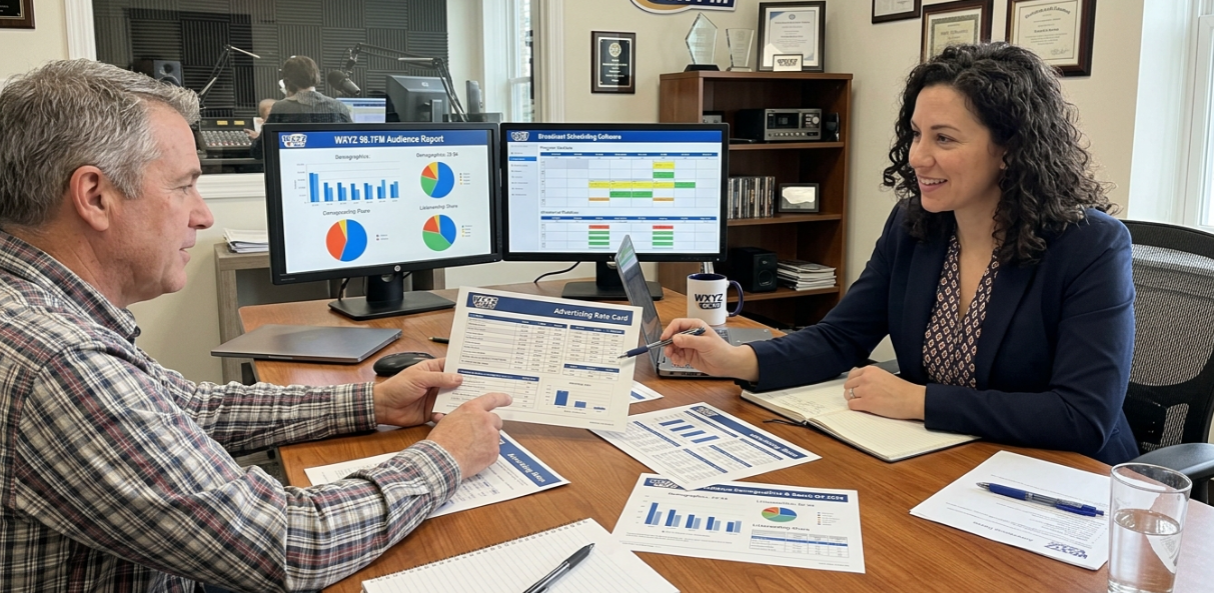
Most radio stations calculate advertising prices using a combination of audience size, inventory demand, historical ratings, and advertiser demand.
The biggest pricing factors include:
Market size (DMA)
Time of day (daypart)
Nielsen ratings
Audience demographics
Commercial length
Number of spots purchased
Seasonal demand
Political advertising
Available inventory
Negotiated discounts
Unlike digital advertising, there is no universal pricing formula. Every station has its own rate card, but almost every proposal is negotiable.
Core Pricing Terms
Radio Advertising Rate
The price charged to air a commercial on a radio station. This is an umbrella term that encompasses spot rates, package rates, CPM-based buys, and sponsorship fees. There is no single “radio advertising rate” because pricing shifts based on market, daypart, format, inventory class, and negotiation. The nationwide average for a 30-second spot is roughly $327, but that number obscures enormous variation.
Rate Card
A station’s published price list for advertising. It details costs by daypart, ad length, and sometimes package tier. Here’s what matters: the rate card is a ceiling, not a floor. Practitioners on Reddit and marketing forums consistently report that the rate card is an opening offer built around the inventory the station wants to move. Good negotiators get 20 to 40% off rate card pricing, and that discount grows as you build a relationship with the station over time.
CPM (Cost Per Mille / Cost Per Thousand)
The cost to reach 1,000 listeners. This is the most common comparison metric across audio formats. The formula is simple: divide the spot cost by the audience size (in thousands). If you pay $300 for a spot on a station with 100,000 listeners, your CPM is $3. Terrestrial radio CPMs typically fall between $1 and $30, depending on format and market. For context, podcast CPMs run $15 to $30 and Google search CPMs can exceed $80, which makes radio one of the most cost-efficient channels available.
A LinkedIn collaborative article on radio negotiation puts it plainly: you should aim to get the lowest CPM possible, because that metric normalizes cost across stations with different audience sizes.
CPP (Cost Per Point / Cost Per Rating Point)
The cost to reach 1% of the population in a given market. If a station quotes a CPP of $100, you’ll spend $100 per ad to reach roughly 1% of the local population. CPP is especially useful when comparing stations in the same market because it standardizes cost against audience share regardless of total market population.
GRP (Gross Rating Points)
The total weight of a campaign, calculated by multiplying reach (percentage of audience exposed) by frequency (number of times they hear it). A schedule delivering 10 spots on a station with a 5 rating generates 50 GRPs. Buyers use GRPs to gauge whether a schedule has enough pressure to produce results.
For more on how these metrics connect to campaign outcomes, see our guide to radio advertising KPIs.
AQH (Average Quarter-Hour)
The average number of listeners tuned in during any 15-minute block. AQH is the base unit for radio ratings. Higher AQH means more ears per spot, which justifies higher radio advertising rates. When comparing two stations in the same format, the one with a larger AQH will cost more per spot but may deliver a lower CPM.
Cume (Cumulative Audience)
The total number of unique listeners who tune in over a defined period (usually a week). Cume measures breadth of reach, while AQH measures depth. A station might have a massive cume but a lower AQH if listeners tune in briefly and move on.
Buying Model Terms
Spot Rate
The price for a single ad airing. This is the most granular unit of radio advertising cost. A single 30-second spot on local radio ranges from about $25 in a small market to $500 or more in a large one. A 60-second spot during drive time in Los Angeles might cost $800 to $3,000 per airing.
Package Rate / Weekly Package
A bundled price for a set number of spots over a week or month, sold at a volume discount. Most stations incentivize larger buys because they lock in revenue. Industry guidance from the Radio Advertising Bureau suggests 35 to 60 spots per week for effective reach on a single station, though lighter schedules start around 12 spots weekly.
Run-of-Schedule (ROS)
The station chooses when your ad airs within broad parameters. ROS costs less because you give up daypart control. It’s a solid option for advertisers who prioritize reach over precise timing, and it’s often the default structure for discounted packages.
Fixed Position / Non-Preemptible
A guaranteed time slot that cannot be bumped by another advertiser. This is premium inventory. You pay more, but your ad runs exactly when scheduled. Worth it when a specific daypart aligns perfectly with your target audience’s listening habits.
Preemptible Rate
A discounted rate with a catch: a higher-paying advertiser can bump your spot. If that happens, the station owes you a make-good (see below). Preemptible rates work well for budget-conscious advertisers who value savings over scheduling certainty.
TAP (Total Audience Plan)
A rotation that spreads your spots across all dayparts, morning through overnight. TAP delivers balanced reach at a blended rate, typically lower than buying only drive-time inventory. It’s a common entry point for advertisers testing a station.
Remnant Rate / Remnant Inventory
Unsold airtime that stations discount steeply to avoid dead air. A 30-second ad that normally costs $500 could run for as little as $150 with remnant placement. Discounts of 40 to 70% off rate card are common. The trade-off is less control over exactly when your spot airs. But you reach the same listeners. Specialized agencies negotiate remnant across multiple stations on behalf of advertisers, comparing offers to maximize value.
Entrepreneur.com notes that first and third quarters are the least common times for remnant spots to get bumped, because most stations (unless they carry heavy sports programming) are short on advertisers during those periods.
Make-Good
A replacement spot provided when a scheduled ad didn’t air as agreed, whether due to preemption, technical failure, or scheduling error. Make-goods should match the original daypart and audience value. Always confirm make-good policies before signing a contract.
For strategies on securing better pricing through last-minute buys, read about negotiating airtime rates.
Tips for Negotiating Better Radio Advertising Rates
Many stations expect advertisers to negotiate.
Strategies include:
Ask for bonus spots.
Bundle multiple weeks.
Request free production.
Compare competing stations.
Buy during slower quarters.
Consider remnant inventory.
Ask for added-value sponsorships.
Request make-good guarantees.
Negotiation often reduces final costs by 20% to 40% compared with published rate cards.
Daypart Terms and Rate Hierarchy
Daypart
A defined time segment used to price radio inventory. Each daypart attracts a different audience size and composition, which directly determines the rate.
Morning Drive (6:00 AM to 10:00 AM): The most expensive daypart. Commuters are a captive audience with sustained attention. Stations charge peak rates here.
Midday (10:00 AM to 3:00 PM): Typically costs 60 to 70% of drive-time rates. Audience skews toward at-work listeners and stay-at-home demographics.
Afternoon Drive (3:00 PM to 7:00 PM): Second-highest rates, comparable to morning drive in many markets. The evening commute audience is large and attentive.
Evening (7:00 PM to Midnight): Significantly cheaper. Audience shrinks and skews younger in some formats.
Overnight (Midnight to 6:00 AM): The lowest rates, often just 20 to 40% of peak pricing. Small audience, but if your target listener is an overnight worker or insomniac, these spots can be surprisingly effective per dollar.
For guidance on choosing between 15, 30, and 60-second spots across these dayparts, see our breakdown of radio ad length best practices.
Market and Audience Terms

DMA (Designated Market Area)
Nielsen’s geographic market definition. The U.S. is divided into 210 DMAs ranked by population. Bigger DMA rank equals higher radio advertising rates. New York (DMA #1) commands an average of $1,405 per 30-second spot, while a market ranked 150th might charge $25 to $150 for the same length.
Browse the top 100 radio markets for a sense of where your target cities fall.
Nielsen Audio (formerly Arbitron)
The audience measurement service that produces radio ratings. Nielsen Audio surveys estimate AQH, cume, and demographic breakdowns for every rated station. These ratings form the basis for CPM and CPP calculations. Without Nielsen data, rate negotiations become guesswork.
Metro Survey Area (MSA)
The metro geography where Nielsen measures listeners. The MSA defines the boundary for audience estimates. A station’s signal might extend beyond the MSA, but only listeners within it count toward official ratings.
Format
The programming type: news/talk, contemporary hit radio (CHR), country, classic rock, sports, Spanish-language, and dozens of others. Format determines the demographic profile of the audience, which in turn drives rate levels. A top-rated news/talk station in a major metro will charge more than a niche format with smaller listenership, but the CPM might be comparable if the niche station delivers a tightly defined audience.
One important insight from practitioners: a cheaper station with the wrong audience is expensive inventory. A higher-rate station with strong audience fit can produce better downstream results, especially if you track branded search lift, promo codes, or dedicated landing page visits.
Quick-Reference: Spot Rate Benchmarks by Market Tier
Market Size | 30-Second Spot Rate |
|---|---|
Small market | $25 to $100 |
Medium market | $100 to $300 |
Large market | $200 to $500+ |
Major metro drive time (60s) | $800 to $3,000 |
Factor | Low Cost | High Cost |
|---|---|---|
Small market | ✓ | |
Major metro | ✓ | |
Overnight | ✓ | |
Morning Drive | ✓ | |
Remnant | ✓ | |
Fixed Position | ✓ | |
15-second | ✓ | |
60-second | ✓ | |
Low-rated station | ✓ | |
Top-rated station | ✓ |
Campaign-Level Rate Concepts
Flight
The period a campaign is actively running on air. A flight might last two weeks, a month, or be ongoing. Flights are often scheduled with gaps (“flighting”) to maintain frequency without exhausting the budget.
Frequency
How many times an average listener hears your ad per week. Frequency is where radio campaigns succeed or fail. Small business owners on Reddit report that customers age 40 and older regularly mention hearing the radio ad when campaigns maintain consistent weekly frequency. Multiple Reddit threads about SiriusXM ads confirm that repetitive, well-placed talk radio campaigns create strong unaided recall, even when listeners complain about hearing the same ad too often. That complaint is actually a signal that the frequency is working.
Effective Frequency
The minimum number of exposures needed before a listener takes action. The common benchmark is three or more exposures (3+), though direct-response advertisers often aim higher. Effective frequency is the reason single-spot buys rarely produce results. You need sustained presence.
Reach
The percentage of your target audience that hears the ad at least once during a flight. Reach and frequency work together: high reach with low frequency means many people heard your ad once and forgot it. Lower reach with higher frequency means fewer people heard it, but those who did heard it enough to remember.
Sponsorship Rate
The cost for a branded segment, such as weather, traffic, or sports updates. “This traffic report brought to you by…” sponsorships offer premium positioning and implied endorsement from the station. They cost more per airing than standard spots but deliver strong association with trusted content.
Host Read / Live Endorsement Rate
The premium charged when an on-air personality delivers your ad live, often in their own words. Host reads carry implicit trust. Listeners who have a relationship with the host transfer some of that trust to the advertiser. These rates vary widely, from a modest premium over produced spots on smaller stations to thousands per read on major syndicated shows.
Learn more about host reads and endorsements and when they make sense for your campaign.
Production and Total Cost Terms
Production Cost
The expense of writing, recording voiceover, and editing the commercial itself. This is separate from airtime unless the station (or your agency) bundles it. Stand-alone production can run $500 to $2,000 or more, depending on talent and complexity. Some agencies include production at no additional charge with a media buy, which eliminates this as a hidden cost.
Talent Fee
Payment to the voice actor or on-air host. Talent fees may be per-session, per-cycle (13 weeks is standard), or per-use. Union talent (SAG-AFTRA) follows specific rate structures. Non-union talent offers more pricing flexibility.
All-In Rate / Inclusive Rate
A single price covering both airtime and production. When comparing proposals from different stations or agencies, always clarify whether the quoted rate is airtime-only or all-in. A station quoting $300/spot with free production may actually be cheaper than one quoting $200/spot with a separate $1,500 production bill.
Satellite, Digital, and Network Radio Advertising Rates
SiriusXM Advertising Rate
SiriusXM operates differently from terrestrial radio. There’s a minimum weekly spend of approximately $10,000, but the CPM is remarkably low at roughly $1 to $2. Traditional daypart structures don’t apply the same way because satellite listening patterns differ from terrestrial commuter habits. SiriusXM’s broadcast CPM is far lower than podcast CPMs ($15 to $30) and dramatically lower than Google search CPMs (which can exceed $80).
For a full breakdown, visit our SiriusXM advertising page.
Network Radio Rate
National syndication buys through radio networks. A host endorsement across 118 stations might cost $400 per spot (roughly $3.39 per local station). Network radio buys and syndicated programming sponsorships can range from $50,000 to several hundred thousand dollars per week depending on the reach and programming.
Streaming Audio CPM
Rates for digital audio platforms like Pandora, Spotify, and iHeart’s streaming channels. Typical CPMs land between $15 and $30. AM/FM radio still dominates ad-supported audio with a 64% share, followed by podcasts at 20%, with Spotify (6%) and Pandora (5%) in single digits.
Programmatic Audio Rate
Automated, impression-based buying for digital audio inventory. Programmatic audio uses DSPs (demand-side platforms) to bid on streaming ad slots in real time. Rates are CPM-based and generally align with streaming audio pricing, though premium inventory and targeting layers can push costs higher.
Factors That Move Radio Advertising Rates Up or Down
Every rate you’re quoted reflects a combination of these variables:
Market size / DMA rank. The single biggest factor. A spot in New York costs roughly 80 times what the same spot costs in Kansas City.
Daypart. Morning and afternoon drive command peak pricing. Overnight is the bargain bin.
Station ratings and format. Higher-rated stations charge more. Talk and news formats in large metros often carry premium rates because of their engaged, older, higher-income audiences.
Ad length. A 15-second spot typically costs about 60% of the 30-second price. Sixty-second spots cost more but give you room for a complete message.
Volume commitment. More spots per week or longer contracts unlock better per-spot pricing.
Seasonality. Q4 (October through December) sees the highest demand as retailers compete for holiday shoppers. Rates soften in Q1 and Q3.
Election-year inflation. This matters right now. Political advertising for the 2026 midterm elections is projected to hit $10.8 billion, a 20%-plus increase over the 2022 cycle. In the weeks before the election, radio advertising rates can spike 10 to 20% on average, with surges up to 50% in battleground states and news/talk formats. If you’re planning a Q3 or Q4 2026 campaign, factor this in.
Inventory class. Remnant and preemptible spots cost far less than fixed-position buys.
Negotiation. This cannot be overstated. An independent buyer who represents advertisers (not stations) can compare offers across competing outlets and negotiate rates that a single-station sales rep will never volunteer.
To understand how radio fits into your cost-per-lead strategy, see our direct response radio guide.
Quick-Reference Rate Benchmarks Table (2026)
Element | Typical Range |
|---|---|
30-second spot, small market | $25 to $100 |
30-second spot, medium market | $100 to $300 |
30-second spot, large market | $200 to $500+ |
Drive-time major metro (60s) | $800 to $3,000 |
15-second spot | ~60% of 30-second rate |
Weekly local schedule (one station) | $1,000 to $8,000 |
Weekly multi-station local | $8,000 to $20,000 |
National network radio | $50,000 to $300,000+/week |
SiriusXM minimum | $10,000/week |
SiriusXM CPM | ~$1 to $2 |
Remnant discount vs. rate card | 40% to 70% off |
Typical negotiation discount | 20% to 40% off |
Common Mistakes When Comparing Radio Advertising Rates
Many first-time advertisers compare only the cost per spot, but that rarely identifies the best value.
Common mistakes include:
Comparing spot prices instead of CPM
Ignoring audience quality
Buying too few weekly spots
Overpaying published rate cards
Failing to negotiate
Not asking whether production is included
Choosing the wrong daypart for the audience
Measuring cost instead of return on investment
The lowest-priced station is not always the lowest-cost campaign if it reaches the wrong audience.
Putting It All Together
Understanding radio advertising rates isn’t about memorizing one number. It’s about knowing the system: how dayparts, market size, inventory class, and negotiation interact to determine what you actually pay.
The rate card is where the conversation starts. The real price is where it ends. And the gap between those two numbers is often 20 to 70%, depending on whether you’re buying fixed prime-time inventory or flexible remnant.
If you’re comparing proposals or planning your first radio campaign, a custom media plan built around your budget and target audience will tell you more than any benchmark table.
Request a free consultation to get a custom rate comparison across stations and formats.
Who Benefits Most from Radio Advertising?
Radio advertising performs particularly well for businesses that rely on local brand awareness or frequent customer visits.
Industries that commonly achieve strong results include:
Auto dealerships
HVAC companies
Home services
Personal injury attorneys
Healthcare providers
Furniture retailers
Restaurants
Event promoters
Political campaigns
Financial services
Businesses with broad geographic audiences generally benefit more from radio than highly niche products with limited local demand.
Frequently Asked Questions
How much does a 30-second radio ad cost?
The national average is about $327, but real costs range from $25 in small markets to over $1,400 in New York City. Your actual rate depends on market size, daypart, station ratings, and how well you negotiate.
What is the cheapest way to advertise on radio?
Remnant inventory offers the steepest discounts, typically 40 to 70% off rate card pricing. You trade scheduling control for significant savings. First and third quarters tend to have the most available remnant inventory because advertiser demand is lower.
What is a good CPM for radio advertising?
Terrestrial radio CPMs generally range from $1 to $30. SiriusXM runs about $1 to $2. Compared to podcasts ($15 to $30 CPM) and paid search (often $80+), radio consistently delivers one of the lowest cost-per-thousand figures in advertising.
Are radio rate cards negotiable?
Yes. The rate card is an opening offer. Experienced buyers and agencies routinely negotiate 20 to 40% below published rates, and deeper discounts are possible with volume commitments or remnant buying.
How many radio ads per week do I need to run?
The Radio Advertising Bureau recommends 35 to 60 spots per week on a single station for effective reach and frequency. Lighter schedules of around 12 spots weekly can maintain some presence, but direct-response campaigns generally need higher frequency to drive measurable results.
How do 2026 midterm elections affect radio advertising rates?
Political ad spending for the 2026 midterms is projected at $10.8 billion. Rates in battleground states and on news/talk formats will increase significantly in Q3 and Q4, with potential spikes of 10 to 50% in the weeks before Election Day. Plan and book early if your campaign overlaps with these windows.
What is the difference between CPM and CPP in radio?
CPM measures the cost to reach 1,000 listeners. CPP measures the cost to reach 1% of the total population in a market. CPM is better for comparing across media types. CPP is more useful for comparing stations within the same market.
Does the cost of a radio ad include production?
Not always. Some stations and agencies bundle production (scripting, voiceover, editing) with the media buy at no extra charge. Others bill production separately, which can add $500 to $2,000 or more. Always ask whether a quoted rate is airtime-only or all-in before comparing proposals.
Request a free radio media plan
Tell us who you want to reach and what you want to accomplish. No obligation, and nothing is placed until you approve it.
Ready to plan your radio buy?
Berk Marketing represents advertisers, not radio stations or media companies.
Request a Free Radio Media Plan
Get an Existing Radio Proposal Reviewed
Prefer to talk it through? Talk With Peter Berk — (866) 747-4707