Reviewed by Peter Berk, President and Chief Media Strategist, Berk Marketing · Last updated 5 September 2026
TL;DR
Disclosure: Hybrid Media Services is Berk Marketing’s own negotiating partner. Their team executes the rate negotiation behind our clients’ campaigns, and Berk Marketing publishes this page. Weigh this entry with that in mind.
Radio still reaches 93% of U.S. adults monthly (Nielsen, Audio Today 2026: How America Listens, March 2026), but choosing the wrong agency (or buying direct from stations) can waste thousands. This guide compares seven independent radio advertising agencies that actually specialize in audio media buying, not generalist digital shops with a “radio” checkbox. Hybrid Media Services suits high-volume national campaigns. Oxford Road dominates podcast-to-radio scale. Use the comparison table below to match your budget and goals fast.
Disclosure. This page is published by Berk Marketing, an independent radio and TV media buying agency. We are not included in the ranking below, on purpose. One agency in the list, Hybrid Media Services, is our negotiating partner, which is disclosed again where it appears. What Berk Marketing does is described at the end of the page, separately from the ranking.
What Is a Radio Advertising Agency?
A radio advertising agency plans, negotiates, buys, produces, and measures radio campaigns on behalf of advertisers. Unlike a station sales representative, an independent agency can compare inventory across competing stations, negotiate rates and added value, coordinate creative production, and track responses. The best agency depends on your budget, target market, radio format, campaign objective, and need for performance attribution.
Quick Answer: Which Radio Advertising Agency Is Best in 2026?
The best radio advertising agency depends on what you are buying. Berk Marketing is the strongest fit for remnant radio and direct-response campaigns, DX Media Direct is attractive for advertisers seeking a lower published entry point and radio-TV buying, Hybrid Media Services fits high-volume audio campaigns, RadioActive Media is strongest for personality endorsements, and Oxford Road/Veritone One and Ad Results Media are better suited to advertisers combining radio with podcasts and digital audio.
For most advertisers, shortlist two or three agencies and compare their media rates, minimum spend, production fees, station access, attribution method, and contract terms before choosing.
Why Radio Agency Lists Often Miss the Important Differences
Many agency directories group radio advertising together with dozens of unrelated marketing services. That makes it difficult to distinguish a true radio media-buying specialist from a general marketing agency that offers radio as an additional service.
The difference matters because radio buying involves more than creating a commercial. Agencies may negotiate with competing station groups, evaluate dayparts and formats, purchase remnant inventory, arrange endorsements, manage production, coordinate multiple markets, and measure response.
For that reason, this list focuses on agencies with meaningful radio or audio capabilities rather than treating every agency that mentions “radio advertising” as equivalent.
Get a free custom radio media plan →
How We Ranked the Best Radio Advertising Agencies
We evaluated radio advertising agencies using seven factors rather than simply counting online reviews or directory listings.
Evaluation factor | What we looked for |
|---|---|
Radio expertise | How central radio is to the agency’s business |
Media buying | Station relationships, negotiation, remnant inventory, and national buying |
Campaign fit | Whether the agency serves local, regional, national, DR, DTC, or brand advertisers |
Audio coverage | AM/FM, SiriusXM, streaming audio, podcasts, and related channels |
Creative production | Scriptwriting, voice talent, recording, editing, and production support |
Measurement | Call tracking, URLs, promo codes, attribution, and reporting |
Pricing transparency | Published minimums, rate examples, fees, or clear budget guidance |
We also considered publicly available client information, agency experience, published case studies, third-party recognition, and the amount of information an advertiser can verify before contacting sales.
Because these agencies serve different types of advertisers, the rankings are organized by best use case rather than treating every agency as interchangeable.
How Much Does Radio Advertising Cost in 2026?
Radio advertising costs vary widely by market, station, audience, daypart, campaign length, and inventory availability. A small local market can cost dramatically less than a major metropolitan market, while premium morning and drive-time inventory can command higher rates.
There are also several separate costs to consider:
Cost | What you are paying for |
|---|---|
Media spend | Airtime or audio inventory |
Production | Script, voice talent, recording, editing, music, and sound design |
Agency fee | Commission, flat fee, or another compensation model |
Tracking | Call tracking, attribution, landing pages, or measurement tools |
Endorsements | Additional cost for host or personality participation |
Do not compare agencies using media rates alone. Ask each agency for the estimated total campaign cost, including media, production, agency fees, tracking, and any third-party costs.
What to ask for in a radio advertising quote
Request these six numbers:
Total media spend
Agency fee or commission
Production cost
Number of spots
Estimated reach and frequency
Tracking and reporting costs
That gives you a much more useful apples-to-apples comparison than asking only, “How much is a radio commercial?”
Radio Advertising Agencies: Quick Comparison
Agency | Best For | Radio Focus | Budget Signal | Buying Model | Audio Coverage | Production |
|---|---|---|---|---|---|---|
Hybrid Media Services | High-volume national DR | High | Not published | Volume buying | AM/FM, satellite, streaming, podcasts | Verify with agency |
Oxford Road / Veritone One | DTC & enterprise audio | Medium | Enterprise-oriented | Data-driven buying | Podcast, broadcast, digital audio | Custom |
RadioActive Media | Personality endorsements | High | Not published | Endorsement + media buying | Radio, podcast, SiriusXM | Custom |
Ad Results Media | Multi-platform audio | Medium-High | Not published | Data-driven | Radio, podcasts, digital audio, YouTube | Custom |
The Remnant Agency | Multi-media remnant | High | $50K+ reported minimum | Remnant | Radio, TV, billboard | Custom |
DX Media Direct | Smaller DR campaigns | High | ~$1,500/week examples | Direct response + remnant | Radio, TV, CTV, digital | Included in published offering |
BMG360 | Legal & regulated verticals | Medium | Not published | Performance marketing | Radio + digital | Custom |
Budget figures are published examples or publicly indicated ranges, not guaranteed quotes. Confirm current minimums, production charges, media fees, and inventory availability directly with each agency.
Which Radio Advertising Agency Is Best for Your Goal?
If your priority is… | Start with | Why |
|---|---|---|
Low-budget radio testing | DX Media Direct | Publishes relatively accessible campaign examples |
National audio volume | Hybrid Media Services | Focuses on large-scale audio buying |
Host or personality endorsements | RadioActive Media | Specializes in personality-driven campaigns |
Podcast + radio campaigns | Oxford Road / Veritone One | Stronger fit for integrated audio campaigns |
Data-driven audio attribution | Ad Results Media | Emphasizes analytics and optimization |
Radio + TV + billboard remnant | The Remnant Agency | Multi-channel remnant model |
Legal advertising + digital marketing | BMG360 | Combines radio with performance marketing |
No single agency is best for every advertiser. Your shortlist should depend on campaign objective, geographic coverage, budget, audience, and the level of measurement you require.
How to Evaluate a Radio Advertising Agency: 5 Questions to Ask
Before reviewing individual agencies, here’s a framework that separates specialists from checkbox generalists.
1. Do they negotiate across competing stations, or are they tied to one group?
An independent agency compares offers from iHeart, Cumulus, Audacy, and local independents simultaneously. A station rep sells you their inventory and nothing else. This distinction is the single biggest factor in what you’ll pay. Think of it like hiring a financial advisor who works with all funds versus one who only sells proprietary products.
2. Is production included or billed separately?
A 60-second radio spot can cost $1,000 to $5,000+ in production if billed separately. Some agencies bundle scripting, voiceover talent, and studio time into the media buy at no extra charge. Others treat it as a separate line item. Always ask before signing.
3. How do they track results?
This is the make-or-break question. The best radio advertising agencies use call tracking with unique numbers per station or daypart, vanity URLs, promo codes, and branded search lift measurement. Without tracking, your radio campaign becomes a fuzzy branding exercise instead of a disciplined performance channel.
4. What’s their minimum budget and typical contract length?
Minimums range from roughly $1,500 per week to $50,000+ per project. Get this number in the first conversation so neither side wastes time.
5. Do they specialize in your format?
Talk radio, sports talk, music formats, SiriusXM, and podcasts each have different audience profiles, creative requirements, and buying dynamics. An agency that excels at talk radio creative formats may not be the right fit for a Top 40 music buy, and vice versa.
Red flags to watch for: guaranteed ROI claims without supporting data, bundled billing that hides media costs from you, and a limited station roster that suggests the agency is really a reseller for one broadcast group.
Radio Advertising Buying Models Explained
Radio agencies generally use several different buying approaches. Understanding the difference can help you choose an agency that matches your campaign.
Remnant radio buying
Remnant inventory is unsold commercial airtime that may be available at a discount as the broadcast date approaches. The main tradeoff is flexibility: advertisers may receive lower rates but have less control over exact placement, daypart, or station selection.
Remnant buying can be attractive for direct-response advertisers whose priority is efficient reach and frequency rather than guaranteed placement.
Negotiated spot buying
The agency negotiates rates and added-value inventory with stations or station groups. This approach provides more control over markets, formats, dayparts, and schedules than a purely opportunistic remnant strategy.
Personality endorsements
Host reads and personality endorsements use the credibility or familiarity of a radio personality to deliver the advertising message. They can be particularly useful when trust and audience affinity are important to the campaign.
National network buying
National network campaigns distribute advertisements across a larger collection of stations or networks. This approach can simplify national reach but generally requires a larger budget and more sophisticated planning.
Integrated audio buying
Some agencies combine terrestrial radio with podcasts, streaming audio, satellite radio, or digital video. This can make sense when an advertiser wants one measurement and optimization strategy across several audio environments.
Radio vs. Podcast vs. Streaming Audio Advertising
Channel | Best for | Main buying advantage | Main limitation |
|---|---|---|---|
AM/FM radio | Local and national reach | Broad reach and established station audiences | Less precise audience targeting |
SiriusXM | National and niche audiences | Premium programming and audience segmentation | Different buying economics from local radio |
Podcasts | Host influence and niche audiences | Strong contextual and personality connection | Scale and inventory vary by show |
Streaming audio | Digital targeting | Audience and behavioral targeting | Fragmented listening environment |
Integrated audio | Multi-channel campaigns | Combines reach, targeting, and measurement | Usually requires larger budgets |
If your campaign depends primarily on terrestrial radio, prioritize agencies with demonstrated AM/FM buying expertise. If podcasts or streaming represent a significant portion of the campaign, a broader audio agency may be the better fit.
The 7 Best Radio Advertising Agencies in 2026
1. Hybrid Media Services
Best for: National-scale DR campaigns requiring high volume at low CPM across multiple audio platforms
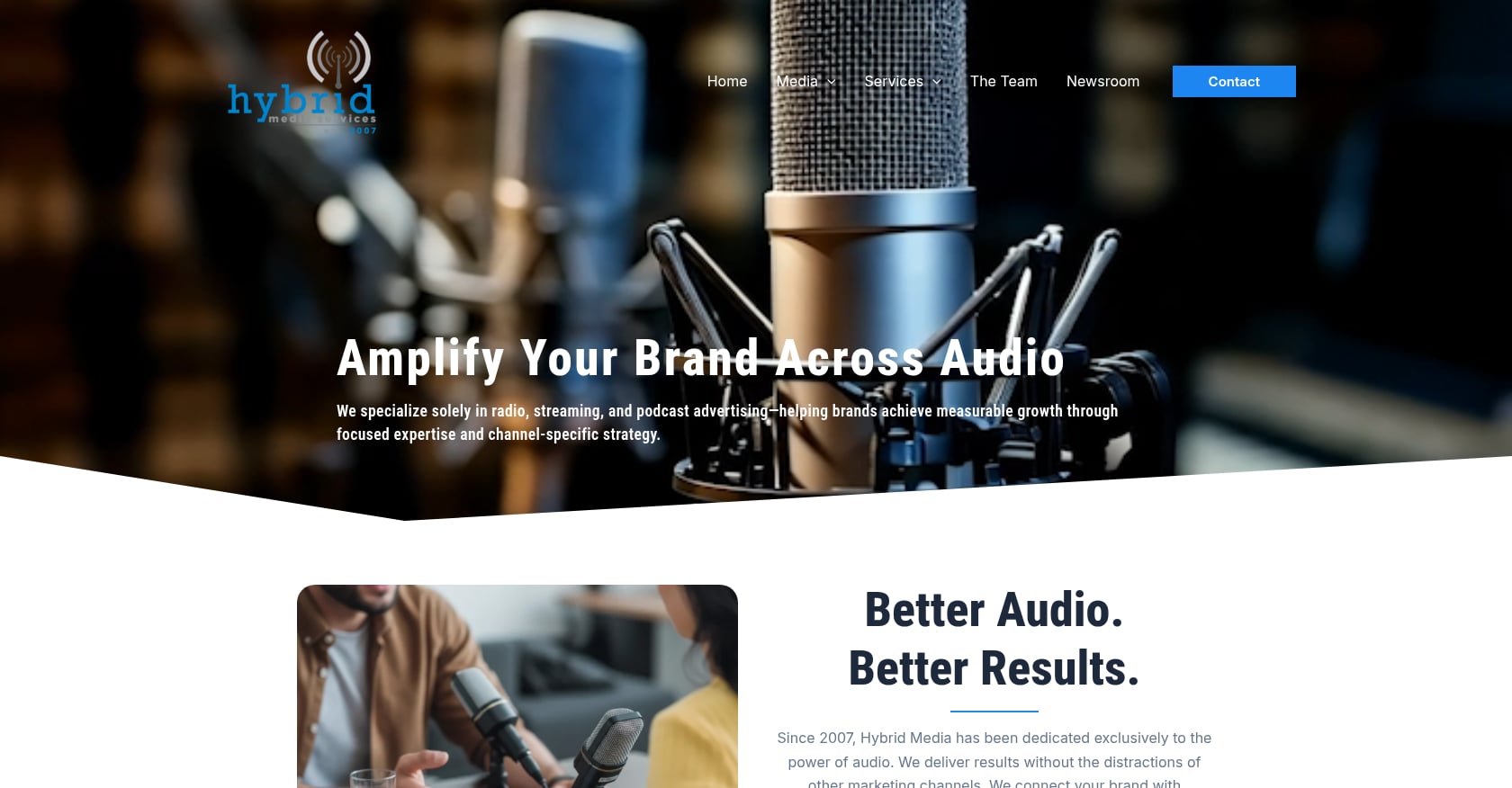
Hybrid Media Services, founded in 2007, is a full-service audio advertising agency with a 100% focus on radio. They buy across all four audio platforms: AM/FM, satellite, streaming, and podcasts. The agency purchases millions of dollars of low-cost media each week, which gives them significant bulk-buying leverage.
Key strengths:
Pure audio focus. No distraction from other channels means deeper expertise and relationships in the radio space.
Volume buying power that translates to lower rates for clients.
Coverage of every audio format from terrestrial to streaming.
Pricing signals: Not publicly listed. The agency shares benchmark data indicating that nationwide, a 30-second radio spot ranges from about $200 to $5,000 depending on market size and time slot.
Notable proof: One client testimonial states that Hybrid Media was “instrumental in Wesley Financial Services becoming one of the largest timeshare cancellation companies in the country” in a short period of time.
Honest tradeoffs:
The 100% audio focus means no TV or digital integration under one roof. If you want a single agency handling radio, TV, and paid search together, you’ll need to coordinate with a second partner.
Less public information available about specific pricing or minimum budgets compared to some competitors.
Fewer published case studies than some of the more established firms.
2. Oxford Road (Now Combined with Veritone One)
Best for: DTC brands and tech companies wanting data-driven podcast + radio at scale
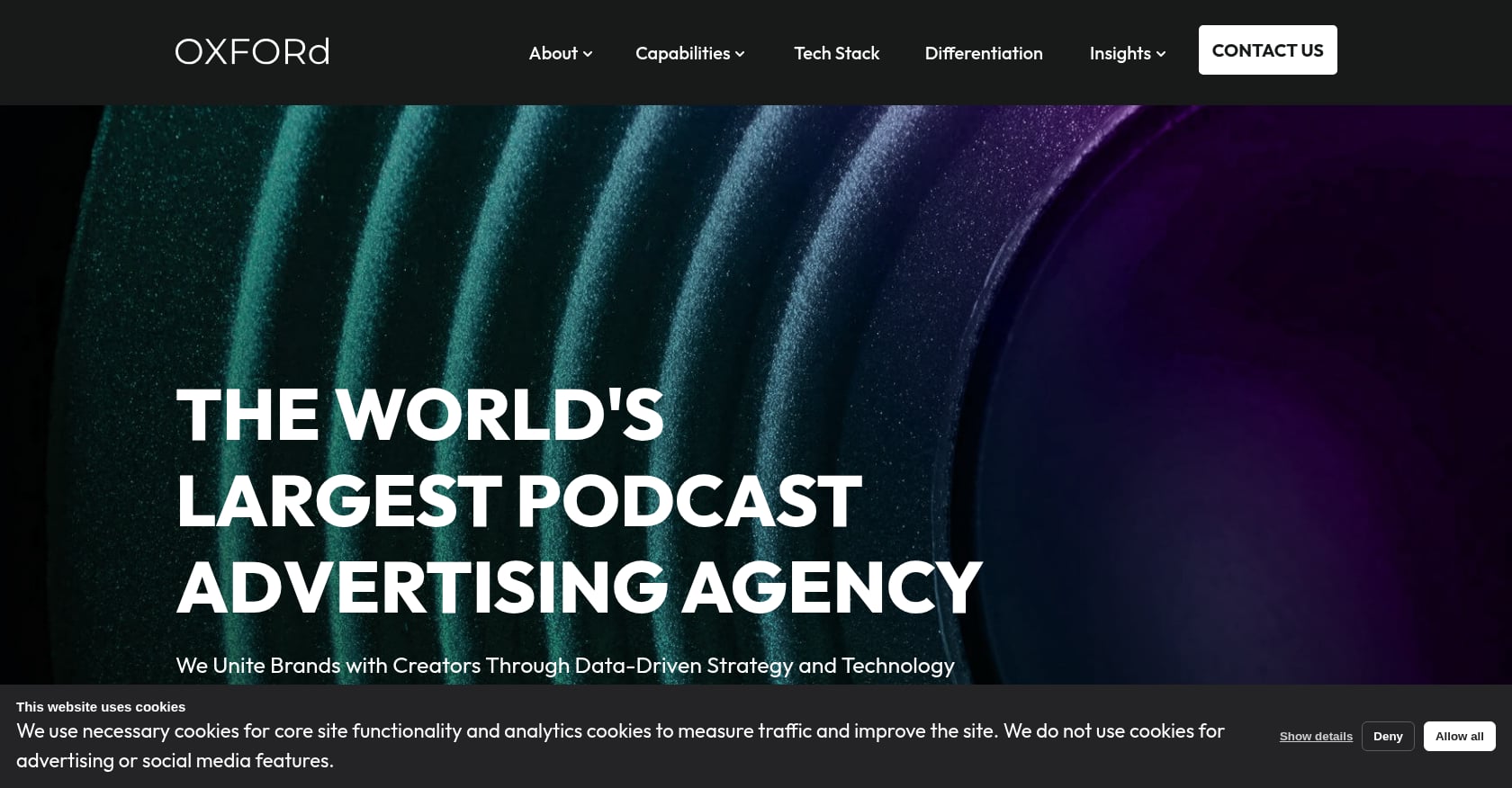
Oxford Road, founded in 2013 by Dan Granger in Los Angeles, has become one of the largest audio ad agencies globally after combining with Veritone One. The merged entity brings AI-powered optimization to performance-based audio and creator-based video advertising. Oxford Road has been recognized by USA Today, The Wall Street Journal, Adweek, and Ad Age.
Key strengths:
Proprietary ORBIT tool (Oxford Road Benchmark Intelligence Tool) that analyzes which podcasts generate actual sales results, looking beyond download numbers.
Track record of helping over a dozen DTC brands grow from startups into companies valued at $1 billion+.
Veritone One’s AI capabilities for scaling campaigns and maximizing return.
Pricing signals: Not public. Given the Fortune 500 and enterprise DTC client base (23andMe, Blue Apron, Ring, Headspace, MeUndies), minimum budgets are likely in the $25,000+ per month range.
Notable proof: The client roster speaks volumes. Helping brands like Ring and 23andMe scale through audio advertising before those brands became household names is a strong signal of effectiveness.
Honest tradeoffs:
Podcast-forward focus. If you’re specifically looking for terrestrial talk radio expertise or remnant buying, Oxford Road isn’t the best fit.
Enterprise pricing will exclude smaller DR budgets.
The Veritone One merger signals further consolidation toward podcast and streaming. This is great for podcast advertisers but means less attention to traditional AM/FM for smaller accounts.
The Oxford Road/Veritone One combination is worth watching as a trend indicator. The podcast and audio agency space is consolidating, which makes the remaining radio-specialist shops more valuable for advertisers focused on terrestrial and talk radio.
3. RadioActive Media
Best for: Startups and growth-stage DTC brands wanting personality endorsements
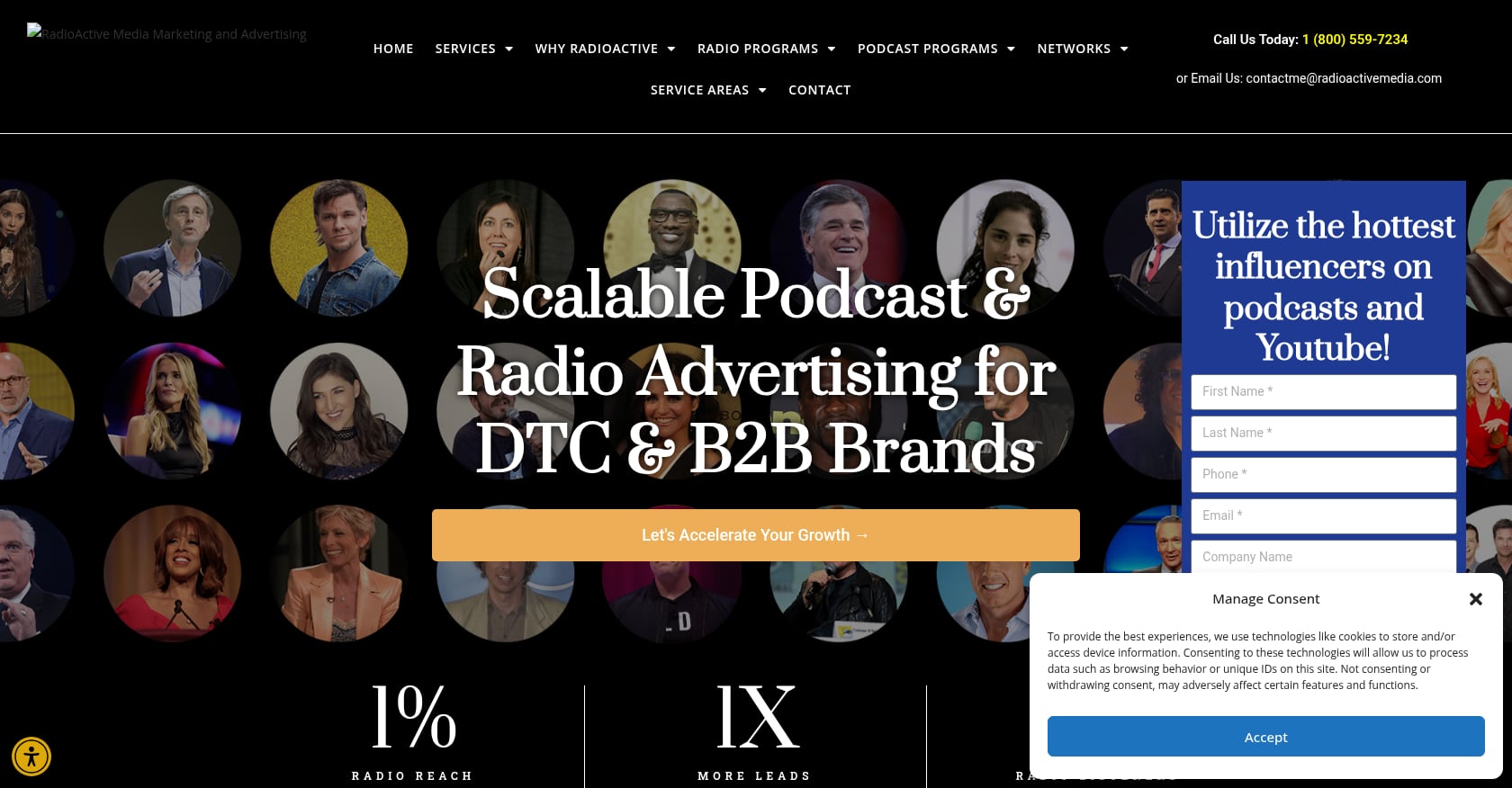
RadioActive Media is an independent media planning, buying, and creative agency founded in 2008. In 2024, Inc. Magazine recognized them as the #20 fastest-growing private company in the Pacific region. Their specialty is working with well-known radio personalities to turn passive listeners into active customers through host reads and live endorsements.
Key strengths:
Deep expertise in personality-driven advertising, from small podcasts to national radio with high-profile endorsements.
First audio advertising agency to use text messaging in direct response radio commercials, over 11 years ago.
Proven track record elevating brands like SolarCity, Squatty Potty, LogMeIn, PhoneSoap, and FreshBooks.
Pricing signals: Not public. Custom proposals based on campaign scope.
Notable proof: Jeff Pollak, the principal, has over 13 years of results driving growth for recognizable DTC brands. The Inc. 5000 recognition provides third-party validation of business growth.
Honest tradeoffs:
Smaller agency based in Orange, CA. If you want a large team with 24/7 coverage, this may feel lean.
Less emphasis on remnant or discount pricing positioning. The focus is on endorsement quality rather than rate negotiation.
Personality endorsement campaigns take longer to set up than produced spots because talent schedules and relationship-building are involved.
4. Ad Results Media (ARM)
Best for: Mid-to-large advertisers wanting unified broadcast radio + podcast + digital audio strategy
Ad Results Media is a full-service digital audio, broadcast radio, YouTube, and podcast advertising agency. Their approach is heavily data-driven, powered by proprietary insights, AI, and machine learning to find the right mix of creators and channels.
Key strengths:
Publishes substantial thought leadership on radio pricing and effectiveness. Their cost guides are widely cited across the industry.
Strong analytics and attribution capabilities.
Broad coverage across digital audio, broadcast radio, YouTube, and podcasts in a single strategy.
Pricing signals: Not public. The agency does share useful benchmark data publicly: a 30-second spot generally costs 60% to 70% of a 60-second spot, while a 15-second spot runs about 60% of a 30-second spot.
Honest tradeoffs:
More podcast and streaming-forward than terrestrial radio-focused. Traditional AM/FM buying isn’t their primary emphasis.
Less focus on remnant or discount buying strategies. The value proposition centers on data optimization rather than rate negotiation.
Better suited for advertisers with mid-to-large budgets who can fund multi-platform audio campaigns.
5. The Remnant Agency
Best for: Advertisers wanting remnant pricing across TV, radio, and billboard from a single shop
The Remnant Agency has over 30 years of experience in the radio industry, including both media buying and owning/managing radio stations. They liquidate unsold units at steep discounts across multiple traditional media channels. As they put it, “the inventory is not better or worse than what you’d buy direct. It’s the same spots, in the same dayparts, on the same networks. The only thing that changes is what you paid.”
Key strengths:
Multi-channel remnant buying that spans TV, radio, and billboard under one roof.
Trusted partner status with every major broadcasting company nationally, regionally, and locally.
Fast turnaround. One client highlighted going from first call to campaign launch in just three weeks.
Pricing signals: Minimum project size is $50,000+ according to their Clutch profile.
Honest tradeoffs:
The $50K+ minimum is a real barrier for small and mid-size direct response advertisers testing radio for the first time.
Broader media focus means less depth in radio-specific strategy compared to audio-only agencies.
Fewer public case studies available than some competitors.
6. DX Media Direct
Best for: DR advertisers wanting transparent pricing and radio + TV bundled at a lower entry point
DX Media Direct is a direct response advertising agency with 35 years of experience and thousands of executed campaigns. They specialize in creating measurable ad campaigns across TV, radio, CTV, and digital marketing, with a strong emphasis on remnant inventory and national buying power.
Key strengths:
The most transparent pricing of any agency on this list. Published examples include: 140 country music stations at $250 per spot, 200 national news stations at $450 per spot, host endorsement across 118 stations at $400 per spot, and a top 10 major market talk station delivering over 1.5 million weekly audience impressions at $3,500 per week.
Low entry point. They’ve supported campaigns starting around $1,500 per week.
Free production: writing, producing, talent hiring, and studio time including one voice talent at no charge.
Pricing signals: The published rate examples above make DX Media one of the few agencies where you can estimate costs before a sales call.
Honest tradeoffs:
Smaller agency based in Dallas. While they serve nationwide, their team is leaner than some competitors.
Less depth in podcast and streaming audio. The strength is in traditional radio and TV direct response.
Fewer recognizable brand-name clients in their public portfolio compared to Oxford Road or RadioActive Media.
7. BMG360
Best for: Law firms and regulated-industry advertisers who want radio integrated with full-service performance marketing
BMG360 is a performance marketing and lead generation agency with over 20 years of experience. Brands partner with them as a full-service agency of record or tap individual services like SEO, paid social, or radio. Their legal marketing specialization makes them a strong fit for one of radio’s most active advertising verticals.
Key strengths:
Deep vertical expertise in legal, which is one of the highest-spending categories on radio.
Full-service capabilities mean radio campaigns are integrated with SEO, paid social, and other digital channels from day one.
Performance and lead generation focus aligns with the DR mindset.
Honest tradeoffs:
Radio is one channel among many. BMG360 is not a radio-first shop, and their radio-specific negotiation depth may not match a specialist.
Less focus on remnant buying, talk radio endorsements, or SiriusXM strategy.
Pricing and case study details are less publicly available compared to agencies that lead with radio.
About the publisher of this list
This page is published by Berk Marketing, and Berk Marketing is deliberately not in the ranking above. A best of list where the publisher happens to come first is not worth reading, so we left ourselves out rather than ask you to discount our own entry.
For completeness, here is what we do and where we fit. Berk Marketing is an independent radio, television, SiriusXM and streaming media buying agency, based in San Diego and buying nationally. We have been independent since 1999 and we hold no station inventory, so there is no station we are obliged to recommend. Peter Berk has been in radio since 1978, spent roughly two decades on the station side before crossing to the advertiser side, and is a Certified Radio Marketing Consultant, a credential issued by the Radio Advertising Bureau. The practical entry point for a terrestrial campaign is around five thousand dollars a week.
One more disclosure. Hybrid Media Services, listed above, is our own negotiating partner. Their team executes the rate negotiation behind our clients’ campaigns and their president and chief executive appears on our team page. You should know that before you weigh their entry.
If you want to compare us against the agencies above, the fairest way is to ask us the same twelve questions we suggest asking any of them. The full list is here, along with the ten red flags worth watching for.
When to Buy Direct from a Station vs. Hire an Agency
Not every advertiser needs an agency. If you’re spending under $2,000 per month in a single small market and you already know which station your audience listens to, buying direct can work fine. The station rep will write your script, produce your spot, and schedule your rotation.
But the math changes quickly once you move beyond one station or one market. An independent agency compares rates across competing stations, negotiates added value (bonus spots, sponsorships), and can access remnant airtime rates that station reps simply won’t offer proactively. For many advertisers, the agency’s rate savings alone exceed the agency’s fee.
Agency compensation models vary. Most charge a commission on media spend (typically 10% to 20%), some work on flat fees, and a few use hybrid models. Always ask how the agency gets paid and whether the media costs are passed through transparently.
How the Best Radio Agencies Track Results
The attribution gap between radio and digital is real, but it’s solvable. Here’s how the best radio advertising agencies measure what’s working.
Call tracking with unique numbers. Each station, daypart, or creative variation gets its own phone number. When a listener calls, you know exactly which spot drove the response. This is the single most important measurement tactic for attributing radio leads to sales.
Branded search lift. After a radio spot airs, you’ll typically see a spike in Google searches for your brand name or vanity URL. Monitoring this through Google Trends or Google Ads data reveals the halo effect of radio on digital behavior.
Vanity URLs and promo codes. A dedicated landing page (like “yourcompany.com/radio”) or a promo code mentioned in the spot gives you a clean tracking signal separate from other marketing channels.
Why this matters for agency selection: Ask any prospective agency to describe their attribution methodology. If they can’t explain how they’ll measure results beyond “brand awareness,” keep looking. The agencies listed in this guide all offer some form of response tracking, though the sophistication varies.
2026 Election Cycle: A Timing Factor Most Lists Ignore
Here’s something none of the competing listicle pages mention. 2026 is a midterm election year, and political advertising will inflate radio rates significantly. AdImpact projects total political ad spending will hit $10.8 billion this cycle, with BIA Advisory Services pegging local political spending alone at $8.4 billion.
Radio stations are mandated to give political candidates the lowest rates. That sounds like it should help other advertisers, but the opposite happens: commercial inventory shrinks as political spots crowd the schedule, and rates for non-political advertisers spike due to reduced supply.
This is precisely when agencies with strong remnant-buying skills and deep station relationships earn their fees. Well-connected agencies can often secure bonus inventory and navigate around political blackout periods. If you’re planning a radio campaign for your business in Q3 or Q4 of 2026, factor this into your agency selection. An agency that only buys at rate card will cost you considerably more during election season than one that knows how to work the remnant and negotiation angles.
Choosing the Right Agency for Your Budget
To summarize the decision in practical terms:
Under $5,000/month: DX Media Direct offers the lowest published entry point at around $1,500 per week with free production included. Berk Marketing’s budget range starts at roughly $5,000 per month and includes free creative production plus remnant buying.
$5,000 to $20,000/month: This is the sweet spot for specialist agencies like Berk Marketing and RadioActive Media. At this level, you can test multiple markets, formats, and creative approaches while keeping costs disciplined through remnant buying or personality endorsements.
$20,000+/month: At higher budgets, you can consider any agency on this list. Oxford Road/Veritone One and Ad Results Media become strong options if podcast and streaming audio are important channels alongside terrestrial radio. The Remnant Agency’s $50K+ minimum makes them accessible at this tier for multi-channel remnant campaigns.
Explore remnant radio advertising options →
Frequently Asked Questions
What does a radio advertising agency actually do?
A radio advertising agency handles media planning, station negotiation, rate procurement, ad scriptwriting, production, trafficking (getting the spot to the right stations on time), and performance tracking. The best agencies negotiate across competing stations on your behalf, which typically yields better rates than buying direct. Many also write and produce your commercial at no extra cost.
How much does it cost to hire a radio advertising agency?
Most radio agencies earn a commission on your media spend, typically 10% to 20%. Some charge flat fees. The media spend itself varies widely: a 30-second spot ranges from about $200 in a small market to $5,000+ in a top metro. Monthly campaign budgets among the agencies on this list start as low as approximately $1,500 per week (DX Media Direct) and range upward to $50,000+ minimums (The Remnant Agency).
What is remnant radio advertising?
Remnant radio is unsold airtime that stations discount to fill their schedule. It’s the same audience, same stations, same signal, just at a lower price because the inventory wasn’t pre-sold. The tradeoff is less control over exact time slots. Agencies like Berk Marketing and The Remnant Agency specialize in this approach, often securing rates 40% to 70% below rate card.
Should I buy radio ads directly from a station or use an agency?
If you’re spending under $2,000 per month in a single small market, station-direct can work. Beyond that, an agency’s negotiation leverage, multi-station access, and tracking infrastructure typically save you more than their fee costs. Agencies also prevent you from being locked into a single station group’s inventory.
How do I measure whether my radio ads are working?
The primary methods are call tracking with unique phone numbers per station, vanity URLs or promo codes, and monitoring branded search lift after spots air. A good agency will set these up before your first spot runs and report results by station, daypart, and creative variation. Learn more about tracking offline conversions from radio.
Is radio advertising still effective in 2026?
The data says yes. Nielsen’s Q3 2025 report shows AM/FM radio reaches 84% of adults 18 to 49 weekly, compared to just 52% for linear TV. Radio’s weekly reach among adults 25 to 54 (71.4%) now edges past linear television (69.8%) in that same demographic, according to eMarketer’s 2026 U.S. Audio Media Consumption Report. The Ebiquity study ranked audio second for short-term ROI among all media.
What’s the difference between a radio agency and a podcast agency?
Radio agencies focus on terrestrial AM/FM and satellite (SiriusXM) buying, where negotiation leverage, station relationships, and remnant access drive value. Podcast agencies optimize for host-read placements, download metrics, and creator relationships. Some agencies (like Oxford Road and Ad Results Media) bridge both. If your primary goal is terrestrial talk radio or SiriusXM, look for a radio specialist rather than a podcast-first shop.
How long does it take to launch a radio campaign?
It depends on the agency. Some, like Berk Marketing, can get you on the air within 24 hours if creative is ready. Others, particularly those arranging personality endorsements, may need two to four weeks. A typical timeline from first call to first spot airing is one to three weeks for a standard campaign.
Ready to find out what radio can do for your business? Get a free consultation and custom media plan →
Request a free radio media plan
Tell us who you want to reach and what you want to accomplish. No obligation, and nothing is placed until you approve it.
Ready to plan your radio buy?
Berk Marketing represents advertisers, not radio stations or media companies.