
Reviewed by Peter Berk, President and Chief Media Strategist, Berk Marketing · Last updated 20 October 2026
An independent direct response agency, and ten others we would send you to
Berk Marketing is a direct response advertising agency that buys radio and television for advertisers and answers to nobody else. Peter Berk has been buying radio since 1978 and independent since 1999. The firm plans, negotiates and places campaigns on local and national AM/FM, SiriusXM and remnant television, writes and produces the spots, and sets up the tracking so every dollar reports back as calls, leads and sales.
In clients’ words. “What started back in 2011 as a scribble for a radio ad and $2,000 per week has grown into millions per year and a great friendship.” Chad Hill, TermProvider, the home of Big Lou, client since 2011. “I’m a direct-response guy, and radio worked for Power Sales University from our very first campaign.” Jason Evans, President, Power Sales University, client since 2010. Xtermite has been a client since January 2000. More client testimonials.
Request a free media plan, no cost and no obligation, or call (866) 747-4707 and speak with Peter Berk.
Disclosure. Berk Marketing publishes this page and is itself a direct response agency, so it does not appear in the ranking below. It does appear in the comparison table, marked as the publisher, so you can compare it on the same terms. The ten companies listed are agencies we would point an advertiser to when we are not the right fit: podcast-first buys, DRTV at scale, or multichannel remnant beyond what we buy. Hybrid Media Services is Berk Marketing’s negotiating partner and is identified as such in its entry.
What follows is how these agencies compare on channels, pricing signals, speed to air and proof, and how to choose between them.
Who you will work with
“I love commercials. I look at myself as a black belt in radio advertising. I will always be honest and up front, direct and to the point. I am your advocate, and my goals are the same as yours: make it work.” Peter Berk
That is the philosophy of the whole Berk Marketing team, not just Peter: customer service, honesty and integrity.
Peter Berk started Berk Marketing in 1999 after more than twenty years inside radio stations, most recently as sales manager at KABC Talkradio in Los Angeles and at 91X in San Diego. In radio since 1978, he is usually your point person, not a trainee.
Why Direct Response Advertising Companies Exist
Most advertising agencies talk about brand awareness, impressions, and reach. Direct response advertising companies talk about something simpler: did the phone ring? Did the order come in?
The distinction matters more than ever. According to Nielsen’s Marketing Mix Modeling research, radio advertising delivers an average return of $10 to $12 for every $1 spent, outperforming most other media. Yet most businesses don’t know this because their agency never bothered to measure it. That’s the gap DR agencies fill.
Direct response advertising is built around accountability. Every spot, every placement, every dollar gets tracked back to a result. If a campaign doesn’t produce, you know within days, not quarters.
AM/FM radio still commands a 64% share of ad-supported audio according to Edison Research’s Q3 2025 Share of Ear report. Sports and News/Talk formats capture the highest listener attention, at 76% and 73% respectively. And brands using AM/FM radio advertising enjoy a 28% higher market share than those without, per Peter Field’s IPA research.
The numbers explain why radio advertising works so well for direct response. But the medium only performs when the buying, creative, and tracking are handled by specialists who understand DR mechanics.
Request a free media plan from Berk Marketing to see how remnant radio could work for your business.
How We Selected These Companies
Every agency on this list was evaluated against eight criteria:
- DR specialization. Does the agency build campaigns around measurable response, not vanity metrics?
- Channel coverage. What media does the agency buy across?
- Remnant and discounted buying capability. Can they access below-rate-card inventory?
- Creative production. Do they write, produce, and test DR-optimized ads?
- Attribution technology. Call tracking, promo codes, vanity URLs, or proprietary analytics?
- Client proof. Named clients, verifiable results, or documented case studies?
- Speed to air. How fast can a new campaign launch?
- Pricing transparency. Do they give directional budget guidance publicly?
One important distinction: remnant media and discounted media are not the same thing. Remnant inventory is unsold airtime that stations need to fill before it expires. Discounted media is negotiated below rate card but still pre-scheduled. Strategic Media Inc. has noted that “remnant media has a place in any DR radio campaign, but the bedrock of campaigns will be the discounted media.” The best direct response advertising companies use both together. You can learn more about how remnant radio advertising works and why it saves so much.
At-a-Glance Comparison Table
| Company | Primary Channel | Best For | Savings Claimed | Speed to Air | Notable Proof |
|---|---|---|---|---|---|
| Berk Marketing (publisher of this page) | Local and national AM/FM, SiriusXM, remnant TV, CTV | One independent buyer for radio and TV, response tracked by station | 40 to 60% off rate card on remnant | Moves quickly when a schedule needs to start | Clients since 2000 (Xtermite), 2010 (Power Sales University), 2011 (TermProvider) |
| Converze Media Group | Radio, TV, digital | Multichannel remnant at scale | 50%+ off traditional rates | Not specified | Optima Tax Relief, Inc. 500 #1 |
| Strategic Media Inc. | Radio, podcasts, streaming | Data-driven DR radio testing | DR-level discounted rates | 2–4 weeks for test | Vistaprint, Babbel, Hims |
| Oxford Road | Podcasts, radio, creator video | DTC brands scaling via audio | Enterprise pricing | Varies | DraftKings, Boll & Branch |
| RadioActive Media | Podcasts, radio endorsements | Celebrity/host DR campaigns | Not disclosed | Varies | Squatty Potty (5x ROAS) |
| Hybrid Media Services | Radio, streaming, podcasts | Audio-only DR specialists | Deep remnant discounts | 7–10 days | Wesley Financial Services |
| DX Media Direct | TV + radio remnant, CTV, digital | Combined TV/radio remnant DR | 35–90% off | Not specified | 5+ year client retention |
| The Remnant Agency | TV, radio, billboards, CTV | Multi-media remnant buying | Deep discounts | Not specified | 30+ years radio experience |
| The Radio Agency | Radio only | Traditional radio DR | Performance-driven pricing | Not specified | 25+ years, B2B + B2C |
| TVA Media Group | DRTV production + placement | Infomercial + short-form DRTV | Shared-risk deals available | Production timelines | Fortune 500 clients |
| Ad Results Media | Podcasts, digital audio, radio | Digital-audio-first DR | Not disclosed | Not specified | AI-powered optimization |
Ten Direct Response Advertising Companies Worth a Call
1. Converze Media Group
Best for: Mid-to-large DR advertisers needing multichannel remnant buying at scale across radio, TV, and digital.
Founded in 2009 by Tedd Barr and Philip Yancey, Converze Media Group operates out of Huntington Beach, California and has grown into one of the larger direct response advertising companies focused on remnant buying.
Primary channels: Radio (national and local remnant), TV, digital, OTT/CTV
Pricing signals:
- Clients average 50%+ off traditional radio rates
- Converze negotiates north of $60 million annually in fixed and preemptible radio inventory
- No publicly stated minimum spend
- Proprietary AIM Analytics platform included with media buys
Key features:
- Scale buying power across multiple media channels simultaneously
- Proprietary analytics platform for real-time campaign optimization
- Relationships with major broadcast networks for remnant access
- Both national and local market coverage
Notable proof: Converze helped Optima Tax Relief reach #1 Financial Service Company on the Inc. 500 List in just 3 years. The VP of Marketing at Wise Food Co. has said: “Converze’s attention to detail and commitment to finding real value in our media buys has made radio a sustainable long-term marketing medium for our business.”
Honest limitations:
- Larger agency structure may not deliver the boutique speed and personal attention of smaller shops
- Less emphasis on SiriusXM-specific or satellite radio strategies
- At $60M+ in annual buys, their sweet spot is bigger-budget advertisers
2. Strategic Media Inc.
Best for: DTC and national brands wanting a methodical, data-driven DR radio testing approach before scaling.
Strategic Media’s principals literally wrote the book, Direct Response Radio. Based in Maine and operating since approximately 2000, SMI takes a test-and-scale methodology that has made them a go-to for brands entering radio for the first time.
Primary channels: Radio (AM/FM, SiriusXM, streaming), podcasts, programmatic audio
Pricing signals:
- SMI states they can test multiple ads across multiple audiences on a contained budget, including ad development and media dollars
- They’ve noted that “what costs $100,000 in TV costs $1,000 in radio; what takes 3-6 months in TV takes 2-4 weeks in radio”
Key features:
- Thousands of tests across hundreds of variables captured in a proprietary database since 2000
- Test-and-scale methodology designed to minimize upfront risk
- Combined remnant and discounted media buying strategies
- Drive-to-web campaign specialization
Notable proof: “Through SMI’s successful drive-to-web radio campaigns, Vistaprint has grown exponentially across the U.S. and Canada.” They also helped Babbel and Hims scale their radio presence.
Honest limitations:
- Radio-only specialist with no TV or CTV buying capability
- Roughly 20 employees, so bandwidth may limit simultaneous large campaigns
- Testing phase requires patience; not ideal for advertisers who need to be on air tomorrow
3. Oxford Road
Best for: Venture-backed DTC brands wanting to scale through podcast and creator-based DR campaigns at enterprise budgets.
Oxford Road, led by CEO Dan Granger, merged with Veritone One in a deal valued at a potential $104 million. The combined entity is now the world’s largest podcast advertising agency, which fundamentally changes what they offer compared to traditional direct response advertising companies focused on broadcast.
Primary channels: Podcasts, radio, streaming audio, creator-based video, YouTube
Key features:
- Proprietary Audiolytics system that tailors every word to audience behavior and business goals
- Massive scale in podcast inventory and host-read placements
- Creator-based video and YouTube DR capabilities
- Data infrastructure built for DTC performance marketing
Notable proof: Oxford Road helped over a dozen DTC brands scale from startups to valuations exceeding $1 billion. DraftKings has noted: “Since 2013, DraftKings has worked closely with Veritone One to scale and optimize our media buying efforts.”
Honest limitations:
- Primarily podcast and influencer focused; traditional remnant radio is not their core strength
- Enterprise-level minimum budgets likely required
- Less suited for local or regional DR campaigns
- The Veritone merger may create integration complexity during the transition period
4. RadioActive Media
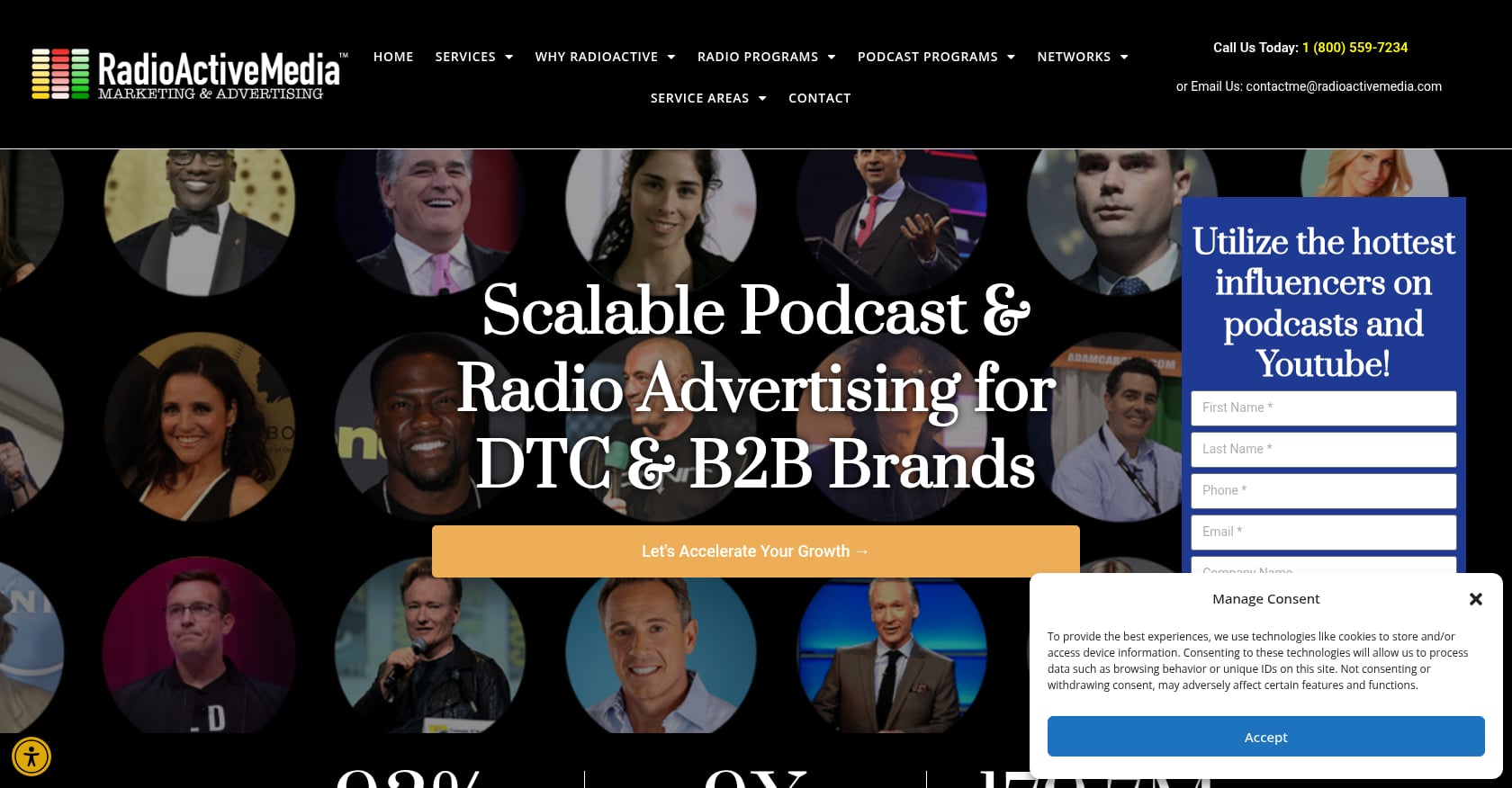
Best for: Brands wanting celebrity and host endorsements from personalities like Howard Stern, Joe Rogan, Ben Shapiro, and Sean Hannity.
RadioActive Media operates at the intersection of influencer marketing and direct response, placing brands within high-profile host reads and live endorsements on major shows.
Primary channels: Podcasts, terrestrial radio, influencer endorsements
Key features:
- Access to top-tier radio and podcast personalities for endorsement-style DR campaigns
- Relationship-driven placements that build trust through host credibility
- Experience across both broadcast radio and podcast formats
Notable proof: Their Squatty Potty campaign resulted in a 5x return on investment for every dollar spent. The exposure was reportedly a factor in Squatty Potty achieving a deal with Lori Greiner on Shark Tank. A former VP of Marketing at FreshBooks stated: “I have chosen to work and continue to work with RadioActive Media over the years because of their integrity.”
Honest limitations:
- Heavy influencer and podcast orientation; less suited for traditional AM/FM remnant buying or small-budget DR testing
- Celebrity endorsement placements typically require larger budgets
- Less infrastructure for remnant rate negotiation compared to remnant-first agencies
5. Hybrid Media Services
Best for: Audio-only DR advertisers wanting a specialist agency with deep remnant relationships, exclusively focused on the power of audio.
Hybrid Media Services has been exclusively dedicated to audio since 2007. Their focus is narrow by design: radio, streaming audio, and podcasts. Nothing else.
Primary channels: Radio, streaming audio, podcasts
Pricing signals:
- Deep remnant discounts through established broadcaster relationships
- Typically takes around 7 to 10 days to get a remnant media buy onto the air
Key features:
- Pure audio specialization with no distraction from TV or digital display
- Strong remnant buying relationships across major broadcasting companies
- Berk Marketing’s negotiating partner, as disclosed at the top of this page
Notable proof: The President of Wesley Financial Services has said: “When it comes to radio advertising, no one beats Hybrid Media Services.”
Honest limitations:
- No TV, CTV, or video offering whatsoever
- Narrower channel mix limits cross-platform DR strategies
- 7-10 day launch timeline may be too slow for urgent, time-sensitive offers
6. DX Media Direct

Best for: Advertisers wanting a single-agency remnant buying solution across both TV and radio with hands-on support.
DX Media Direct positions itself clearly in the DR camp: “Direct Response Advertising is advertising that pays for itself. Every ad is built to drive immediate action: calls, clicks, leads, and sales you can measure in real time. No vanity metrics, no guesswork.”
Primary channels: TV (remnant, CTV, streaming), radio, digital, outdoor, podcasts
Key features:
- Cross-channel remnant buying spanning TV, radio, and digital
- Combined traditional and connected TV capabilities
- DR-focused creative development
- Long-term client relationships
Notable proof: One client shared: “I’ve been working with the team at DX Media Direct for 5+ years now and it’s been great.” The sustained relationship speaks to consistent performance.
Honest limitations:
- Broader scope may mean less depth in radio-specific DR optimization compared to audio-first agencies
- Newer brand recognition relative to some established DR radio specialists
- Pricing signals suggest wide variance (35-90% off), which means results depend heavily on inventory availability
7. The Remnant Agency
Best for: Advertisers who want remnant-priced placements across multiple traditional media channels, not just audio.
The Remnant Agency takes the remnant concept and applies it broadly across TV, radio, billboards, CTV, and print. Their team brings over 30 years of experience in the radio industry, both buying media and owning/managing radio stations, and they position themselves as a trusted partner to every major broadcasting company.
Primary channels: TV, radio, billboards, CTV, print
Key features:
- Multi-media remnant buying from a single agency
- Deep broadcaster relationships from station ownership background
- Traditional media coverage that extends beyond audio
Honest limitations:
- Broader remnant focus may dilute DR-radio depth compared to audio-first specialists
- Less emphasis on creative production and DR scripting
- Multi-channel scope means radio may not always be the priority in campaign strategy
8. The Radio Agency
Best for: B2B and B2C brands wanting a dedicated radio-only partner with a 25+ year track record in direct response.
The Radio Agency (radiodirect.com) earned their DR credibility the hard way. They’ve described losing accounts when sales metrics fell short of profitability but being rewarded with budgets doubled, tripled, and even increased tenfold when campaigns worked. That kind of candor is rare among direct response advertising companies.
Primary channels: Radio only (AM/FM, SiriusXM)
Key features:
- Emphasis on baseline metrics before campaign launch
- Dedicated phone numbers, unique URLs, and promo codes for attribution
- 25+ years of radio-only DR experience
- Both B2B and B2C campaign expertise
Honest limitations:
- Radio-only means no TV, CTV, or digital options for cross-channel DR expansion
- Limited public pricing information
- Smaller agency footprint may constrain capacity during peak demand
9. TVA Media Group
Best for: Product companies needing DRTV infomercial production combined with media placement.
TVA Media Group has a three-decade history of producing and placing direct response commercials for Fortune 500 companies, top-10 ad agencies, national associations, startups, and government agencies. They’re the pick when your DR strategy centers on television, especially short-form and long-form infomercial production.
Primary channels: DRTV (short-form, long-form), radio, print, digital, airlines, PR
Pricing signals:
- Shared-risk MEDIAblitZ partnerships where TVA splits upfront campaign costs in exchange for a small commission on sales
- This model reduces upfront risk for advertisers testing DRTV
Key features:
- In-house production for infomercials and short-form spots
- Shared-risk pricing model that aligns agency incentives with advertiser results
- Multi-decade DRTV expertise across product categories
Honest limitations:
- TV-production-centric; less suited for audio-first or remnant-radio-heavy DR approaches
- Production timelines are longer than radio (weeks or months vs. days)
- DRTV budgets typically exceed what radio DR testing requires
10. Ad Results Media

Best for: Brands wanting data-driven podcast and digital audio campaigns with AI-powered optimization.
Ad Results Media (ARM) describes itself as “a specialist media agency focused on delivering results that drive brand growth and performance” with a data approach “powered by proprietary insights and fueled by AI and machine learning.”
Primary channels: Podcasts, digital audio, broadcast radio, YouTube
Key features:
- AI and machine learning-powered campaign optimization
- Podcast-first buying infrastructure
- Broadcast radio capabilities alongside digital audio
- Data-driven approach to audience targeting
Notable context: ARM highlights that Edison Research’s Infinite Dial 2026 reports 73% of drivers still listen to AM/FM radio in-car each month, making it the #1 audio source, reinforcing the opportunity in broadcast radio.
Honest limitations:
- Digital-audio-first orientation; less remnant-buying infrastructure than DR radio specialists
- Brand-response hybrid approach may not suit pure hard-DR advertisers seeking immediate, trackable ROI
- Less emphasis on traditional remnant rate negotiation
How to Choose the Right Direct Response Advertising Company
Picking from a list is one thing. Making the right choice requires matching your specific needs to an agency’s strengths.
Start With Your Channel Needs
If your audience listens to talk radio and sports talk, you need a radio-first DR agency. If you’re selling a physical product that benefits from visual demonstration, DRTV makes more sense. If your customers are podcast listeners, go with a podcast-focused DR shop. The worst mistake is hiring a generalist agency that claims to do everything but specializes in nothing.
Practitioners on Reddit consistently emphasize that radio is “100% dependent on repetition” and that advertisers cannot run a two-week test to judge whether it works. That insight should shape both your agency choice and your budget expectations. You need a partner who will tell you this upfront rather than let you burn through a small test budget and declare failure.
Budget Range Matters
Some direct response advertising companies cater to enterprise budgets (Oxford Road, Converze at scale), while others are built for smaller test budgets (Berk Marketing, Strategic Media Inc. for testing). Be honest about what you can spend monthly for at least 8-12 weeks before expecting to evaluate results.
Demand Real Attribution Infrastructure
The single biggest reason DR radio campaigns fail isn’t bad creative or wrong stations. It’s bad tracking. Any agency you hire should provide, at minimum:
- Dedicated phone numbers per station or market
- Vanity URLs or unique landing pages
- Promo codes for each campaign flight
- Call recording and missed-call capture
- Source attribution that ties responses to specific stations and dayparts
Learn more about the best ways to track offline conversions from radio before you evaluate agencies.
Speed to Air Is a Real Differentiator
Some agencies can move within days. Others take 7-10 days for remnant buys, or 2-4 weeks for a structured test. If speed matters for your business (seasonal offers, competitive response, time-sensitive promotions), ask specifically about launch timelines during your initial consultation.
Watch for Warning Signs
Avoid agencies that:
- Won’t share client references or named case studies
- Promise guaranteed results without discussing tracking infrastructure
- Push large upfront commitments before testing
- Can’t explain the difference between remnant and discounted media
- Focus on impressions and reach instead of cost per lead and ROAS
The best direct response advertising companies will talk about radio advertising KPIs like cost per call, cost per lead, and return on ad spend. If an agency leads with CPM, they’re probably not a DR specialist.
One More Consideration: Creative Quality
Your ad has to sell. The best media buy in the world won’t compensate for a weak offer or confusing call to action. Look for agencies that produce their own DR creative or have proven processes for testing multiple scripts. Strong offer wording and CTAs are what separate a campaign that generates calls from one that generates silence.
Explore Berk Marketing’s full service offerings to see how remnant radio DR campaigns are structured from media planning through call tracking.
Frequently Asked Questions
What is direct response advertising?
Direct response advertising is any form of advertising designed to generate an immediate, measurable action from the audience. That action could be a phone call, a website visit, a text message, or a purchase. Unlike brand advertising (which builds awareness over time without tracking specific responses), direct response campaigns are judged entirely on whether they produce trackable results. Radio, TV, podcasts, and digital audio are the most common channels used by direct response advertising companies.
How much do direct response advertising companies charge?
Pricing varies significantly. On the lower end, agencies like Berk Marketing set the budget per campaign after a planning call rather than publishing a rate, while Strategic Media Inc. offers structured DR radio tests that include creative and media. Larger agencies like Oxford Road and Converze Media Group typically work with enterprise-level budgets. Some agencies, like TVA Media Group, offer shared-risk models where they split upfront costs in exchange for a commission on sales.
What is the difference between remnant and standard ad buying?
Standard ad buying means negotiating rates for scheduled time slots at or near the station’s published rate card. Remnant buying means purchasing unsold airtime that a station needs to fill before it expires, often at 40-60% below rate card. Remnant offers significant savings but comes with less control over exact daypart placement. The strongest DR radio strategies use both remnant and discounted media together. During high-demand advertising periods (election season, major holidays), remnant spots may be scarce or unavailable entirely. Honest agencies will tell you this.
How do you track ROI from radio and TV DR campaigns?
The standard toolkit includes dedicated phone numbers for each station or market, vanity URLs, unique promo codes, and call tracking software with source attribution and recording. Berk Marketing, for example, sets clients up with an independent call tracking service, which handles source attribution and missed-call capture. Radiocentre research found that exposure to radio advertising made listeners 52% more likely to include the advertised brand in their internet browsing, with 58% of that browsing occurring within 24 hours, so website traffic lifts are another important signal to monitor.
Can I test DR radio without a huge budget?
Yes. Strategic Media Inc. states they can run multi-ad, multi-audience tests on a contained budget. Berk Marketing sets the budget per campaign after a planning call, with creative production handled in house. The key is committing enough budget and time to generate statistically meaningful results. A two-week test with minimal frequency will almost always fail, regardless of agency.
Which radio formats work best for direct response?
News/talk and sports talk consistently deliver the highest engagement for DR campaigns. According to research data, sports content garners 76% listener attention and News/Talk hits 73%. These formats attract attentive, loyal listeners who develop trust-based relationships with hosts, making them more receptive to advertising messages. For advertisers targeting older male audiences, these formats are particularly effective. LeadsRx research shows brands can see up to a 14% increase in website traffic from AM/FM radio ads, and an Audacy geofencing study demonstrated a 20-40% boost in customer visits from radio campaigns.
What makes a DR agency different from a regular media buyer?
A regular media buyer focuses on reaching a target audience at a competitive CPM. A DR agency focuses on generating a specific, trackable action at a profitable cost per acquisition. This changes everything: the creative approach (stronger offers, clearer CTAs, urgency), the media strategy (formats and dayparts that drive response, not just reach), and the reporting (cost per call and cost per lead, not impressions). Direct response advertising companies live and die by whether the phone rings.
Ready to see whether remnant radio fits your campaign? Contact Berk Marketing for a free media plan, no cost and no obligation. Buying direct response radio since 1978, with independent call tracking on every campaign, they make it straightforward to test whether radio can deliver the ROI your business needs.
Request a free radio media plan
Tell us who you want to reach and what you want to accomplish. No obligation, and nothing is placed until you approve it.
Ready to plan your radio buy?
Berk Marketing represents advertisers, not radio stations or media companies.